
A piece of poorly chewed meat, a bite of bread swallowed too quickly during an animated meal, and the throat gets blocked. The sensation is immediate: pressure, inability to swallow, sometimes difficulty breathing. Knowing how to distinguish a simple esophageal blockage from a serious choking incident changes the response and, in some cases, saves a life.
Partial or total obstruction: two situations not to confuse
The first reflex when faced with food stuck in the throat should be to assess the severity. Two scenarios exist, and they require different actions.
When the person is coughing strongly, speaking, or making sounds, the obstruction is partial. Air is still passing. Coughing is the most effective defense mechanism: it generates enough pressure to expel the piece. Do not slap the back of someone who is coughing effectively. You risk moving the food and worsening the blockage.
When the person can no longer speak, is no longer coughing, and instinctively brings their hands to their throat, the obstruction is total. Air is no longer circulating. The skin may take on a bluish hue around the lips. This is a vital emergency that requires action within seconds. To better understand how to react to a food stuck in the throat what to do depending on the situation, one must know the appropriate actions for each case.
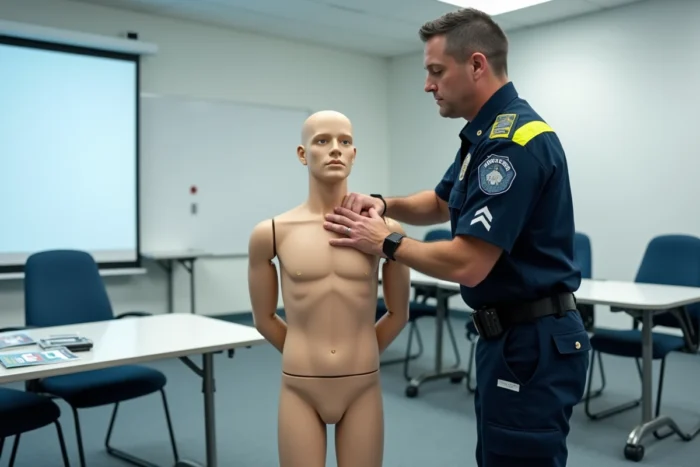
Back slaps and Heimlich maneuver: precise technique for adults
The first aid actions follow a specific order. Always start with back slaps before moving on to abdominal compressions.
Back slaps between the shoulder blades
Position yourself beside the victim. Lean them forward while supporting them with one hand on the chest. With the heel of your other hand, deliver up to five firm slaps between the shoulder blades.
Each slap should be dry and firm, not a tap. The goal is to create a vibration that dislodges the food. Check between each slap if the piece has been expelled. If it comes out, stop.
The Heimlich maneuver in case of failure
If the slaps do not work, move on to abdominal compression. Position yourself behind the person. Place your closed fist (thumb inward) between the navel and the bottom of the sternum. Cover this fist with your other hand.
Apply a quick pressure backward and upward. Repeat up to five times. The abdominal compression forces residual air out of the lungs, creating a piston effect that can dislodge the food.
If the obstruction persists after this sequence, alternate: five back slaps, then five abdominal compressions. Call 15 (SAMU) or 112 at the beginning if someone else is present; otherwise, after the first cycle of actions.
Common mistakes that worsen the situation during choking
Some spontaneous reflexes are counterproductive. The French Society of Emergency Medicine (SFMU) and the French Society of Anesthesia and Resuscitation (SFAR) emphasize a often overlooked point: blind attempts in the mouth increase the risk of foreign body migration. Pushing fingers in to retrieve a piece can push it deeper into the airways.
Here are the actions to avoid:
- Inserting fingers into the victim’s mouth without clearly seeing the object, as this can worsen the obstruction or cause injuries
- Giving something to drink to “wash down” the food, which does not work in the case of airway blockage and risks causing further aspiration
- Repeated abdominal compressions for an extended period without calling for help, as esophageal or abdominal injuries may occur
The recommendations from SFMU and SFAR also specify that one must know when to stop the maneuvers and transfer to an emergency facility rather than persist. Knowing when to cease first aid actions and hand over to emergency services is an integral part of the response.

Food stuck in the esophagus without choking: when discomfort persists after a meal
Have you ever felt that sensation of a piece stuck at the level of the sternum, without real difficulty breathing? This scenario is different from choking. The food has passed into the esophagus (the tube leading to the stomach), not into the trachea. You are breathing normally, but swallowing is painful or impossible.
In most cases, these foods stuck in the esophagus dislodge spontaneously, without medical assistance. Waiting a little while while remaining calm is often enough. However, an esophageal blockage lasting more than a few hours requires a consultation, as the risk of perforation of the esophagus increases over time.
Some online sources recommend drinking cola to “unstick” the food. This practice is now discouraged without medical supervision. An endoscopic intervention, performed by a gastroenterologist, remains the reference method when the food does not dislodge on its own.
Repeated blockages: the warning signal of an underlying dysphagia
An isolated food blockage is generally a benign accident. But when episodes repeat, the question is no longer “how to unblock” but “why is it blocking”.
Dysphagia (chronic difficulty swallowing) affects a broader population than just the elderly. It can signal a narrowing of the esophagus, chronic inflammation, or atypical gastroesophageal reflux. A silent reflux causes coughing, throat clearing, and a sensation of a foreign body without burning. This misleading picture often delays diagnosis.
If you regularly experience discomfort while swallowing during meals, a sensation of food that “won’t go down,” or if you have to drink systematically to get the bites down, consult a doctor. An ENT or gastroenterological assessment can help identify the cause and prevent a simple discomfort from turning into an emergency.
A choking incident plays out in a matter of seconds. Knowing the sequence of back slaps followed by Heimlich, knowing when to stop and call 15, differentiating an esophageal blockage from a tracheal obstruction: these practical guidelines cover the vast majority of situations.