
Bamboo torture refers to a punishment where a plant shoot, as it grows, would slowly pierce the body of an immobilized prisoner. This story has circulated for centuries, associated with several countries in East and South Asia. But behind the terrifying image lies a much more nuanced reality, where legend has often taken precedence over documented facts.
Bamboo as a weapon: what botany really allows
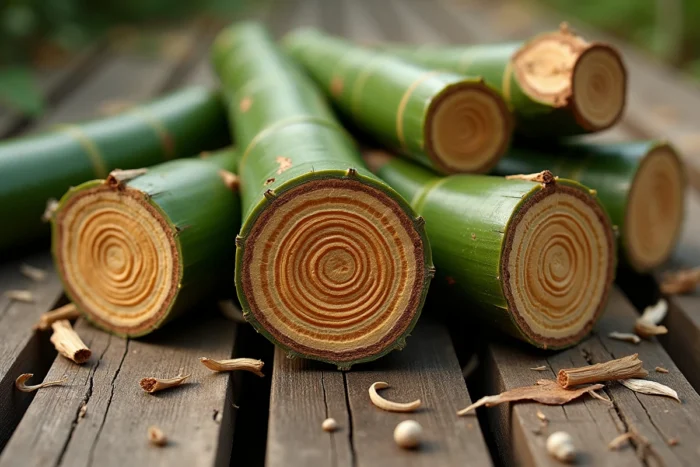
Before discussing torture, one must understand the plant itself. Some species of bamboo are among the fastest-growing plants in the world. Some shoots grow several centimeters per hour, making it a unique case in the plant kingdom.
The young shoot, sharp and rigid, exerts upward mechanical pressure as it develops. It is capable of penetrating relatively dense materials, such as compacted soil. This biological property has fueled the idea that a shoot could pierce human skin if a body were held above it.
Some modern experiments, notably one broadcast by the show MythBusters, have shown that a bamboo shoot could indeed penetrate a substitute for flesh in a few days. The experiment used a ballistic dummy, not a human body. The mechanical feasibility does not prove the actual historical use.
To better understand the history of bamboo torture, one must distinguish what the plant makes physically possible and what the records confirm.
Bamboo torture: a myth constructed by Western orientalism
Why is this punishment so famous when no material evidence documents it? The answer lies in one word: orientalism.
No Asian judicial or military archive confirms this practice. No court record, no officer report, no verified direct testimony. The earliest mentions come from Western accounts, often written by travelers, missionaries, or journalists who did not witness the scene themselves.
The mechanism is classic. A traveler reports a local rumor. An illustrated newspaper picks it up with a dramatic engraving. Other publications cite this newspaper as a source. Within a few decades, the second-hand account becomes a “historical fact” repeated without verification.
A fantasy of cruelty attributed to the Other
This process fits into a broader tradition. Colonial West has often projected barbaric practices onto Asian societies to justify its own “civilizing” mission. Bamboo torture is more a product of oriental fantasy than documented fact.
Researchers who have analyzed this file emphasize a specific point: cultures where bamboo grows naturally (China, Japan, India, Southeast Asia) do not have, in their own archives, reliable traces of this method. The punishment of impalement, however, is attested in other regions of the world, but with different techniques.
Testimonies from World War II and prisoners of war
The narrative gained renewed notoriety during World War II. Allied prisoners of war held by the Japanese army reported being threatened with bamboo torture. Some testimonies mention staged scenarios intended to terrorize the captives.
A civilian interned in Makassar (in present-day Indonesia) reportedly described the method in an account circulated after the war. This often-cited testimony remains isolated and uncorroborated by other direct sources.
- No military medical report describing injuries compatible with a bamboo shoot penetrating a body has been found in known archives.
- Testimonies mainly pertain to psychological threats, not the actual execution of the punishment.
- War propaganda from both sides amplified this type of narrative to demonize the opponent.
The boundary between real torture and psychological weapon is very blurred here. The threat of the punishment may have been used more than the punishment itself.
Bamboo and popular culture: how fiction sustains the myth
Films, series, video games, and comic books have widely adopted the image of bamboo torture. This visibility in fiction reinforces the idea that the practice was common, whereas the opposite is true: it is the repetition of the narrative motif that creates the historical illusion.
War cinema and espionage thrillers have particularly exploited this device. The typical scene shows a prisoner tied above shoots, with an unrelenting biological countdown. This scenario works dramatically, but it is not based on any reliable reconstruction.
A confirmation loop between fiction and encyclopedias
An interesting phenomenon is observed online. Encyclopedic articles cite fictions as proof of the existence of the punishment. These same articles then serve as sources for new fictions. The myth feeds on its own circulation, without ever returning to a verifiable primary source.
- The show MythBusters tested physical feasibility, not historical reality, but many articles conflate the two.
- Sixteenth-century engravings depicting impalements are sometimes associated with bamboo without proven links.
- Social media amplifies the phenomenon through short posts that present the punishment as an established fact.
Bamboo torture illustrates how a narrative can become “true” through the accumulation of repetitions, without any original evidence to support it. The study of this myth teaches as much about the mechanisms of historical misinformation as it does about the practices of torture themselves. What remains attested is the capacity of the narrative to terrify, and perhaps that is where its true function lay.