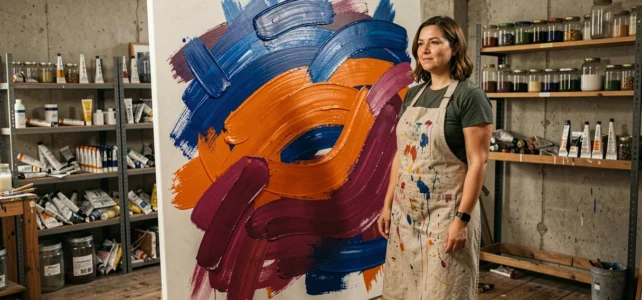
Contemporary colorful abstract art stands at the crossroads of several transformations: the rise of generative AI in studios, new European regulatory obligations, and the redefinition of palettes by artists exploring color as an autonomous material. Measuring these evolutions allows us to distinguish what constitutes a lasting trend from what remains a passing fad.
Colorful abstract art and generative AI: what the AI Act changes for artists
Since August 2, 2026, the transparency rules of the European Regulation on Artificial Intelligence (AI Act) apply throughout the Union. Any content generated or modified by AI must be disclosed to users, with machine-readable labeling and standardized icons.
Works that are clearly artistic or creative benefit from a visible banner exception. However, artists must still appropriately indicate that they have used AI technologies to produce or modify the content.
| Criterion | Abstract work without AI | Abstract work with AI assistance |
|---|---|---|
| Machine labeling obligation | None | Yes (AI Act, art. transparency) |
| Visible banner for the public | Not applicable | Exempt if artistic work, but mention required |
| Sanctions for non-compliance | Not applicable | Fines provided by Regulation (EU) 2024/1689 |
| Impact on gallery sales in the EU | No change | Mandatory information to the buyer |
For an abstract painter using AI to generate textures, color variations, or preparatory compositions, the line between tool and co-creation becomes a concrete legal issue. The artist remains free not to display a banner on the work itself, but the distribution platform or online gallery must ensure traceability.
Creators like Fanny Music, whose work is visible on fannylngart.com, illustrate this generation of artists who articulate physical painting and digital exploration of colors while remaining in a largely manual process.
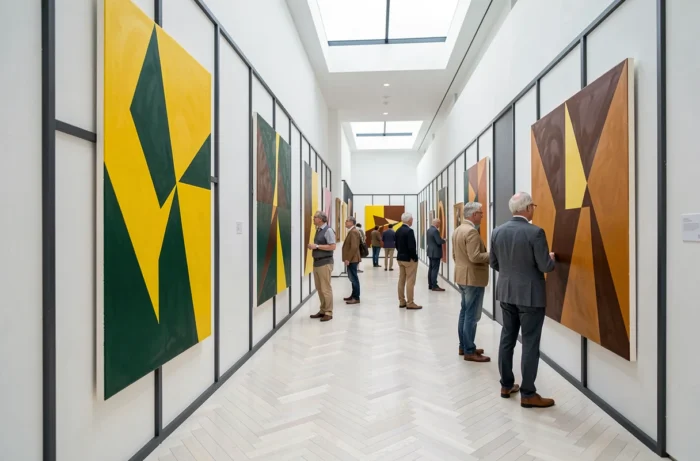
Saturated palette versus neutral tones: what distinguishes contemporary colorful abstraction
Colorful abstraction is not just about applying bright pigments to a canvas. It relies on a work of layering, contrast, and resonance between colors that produces an autonomous visual energy, without figurative reference.
In contrast, contemporary abstraction dominated by neutral tones (grays, off-whites, blacks) seeks effect through material and texture rather than chromatic saturation. Both approaches coexist in galleries and fairs, but they do not address the same sensibilities.
- Colorful abstraction favors high-pigmentation acrylics, inks, and sometimes tinted resins to achieve lasting luminous intensity on the canvas
- Artists working in neutral tones use more oil, texture mediums, and coatings, with a tactile vocabulary rather than a chromatic one
- In the secondary market, highly colorful abstract paintings attract a clientele of novice collectors, often drawn by the immediate decorative impact in a contemporary interior
- Monochrome works or those with a limited palette find it easier to fit into institutional collections and professional spaces
The choice of saturated color is not a decorative choice but an aesthetic stance that engages the artist in a dialogue with ambient light and the hanging space.
Contemporary color techniques in abstract painting
The gesture of the contemporary colorful abstract painter relies on techniques that have significantly evolved from mid-20th century abstract expressionism. Current synthetic pigments offer a color range that Kandinsky or Joan Mitchell did not have access to.
Layering and transparency
Working in successive layers of transparent colors allows for the creation of optical depth. Each layer modifies the perception of the previous one. The final color only exists through accumulation, which makes each painting unique even within a series.
This approach requires a drying time between each layer, imposing a slow working rhythm, in contrast to the image of spontaneous and rapid abstract art.
Pouring and controlled projection
The pouring technique (fluid paint pouring) is experiencing a resurgence of interest. It produces effects of cells and colored marbling that the artist guides without fully controlling. The result oscillates between chance and intention.
The energy of the gesture remains the main driving force of colorful abstraction, even when the artist uses unconventional tools: oversized spatulas, textured rollers, gravity projection.
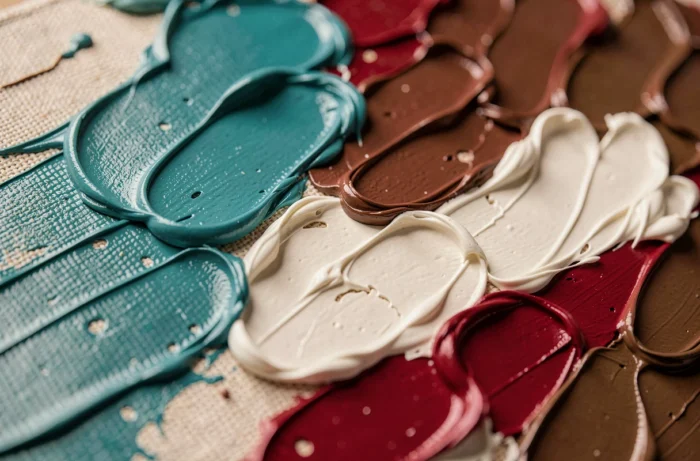
Colorful abstract art and AI regulation: a redefining market
Regulation (EU) 2024/1689 concerns not only creation. It also affects the online distribution of works. Generative AI systems already present in the European market have a transitional period to comply with the new transparency obligations.
For abstract artists who use these tools as aids in composition or chromatic exploration, the question now arises at each exhibition or sale: what degree of AI intervention requires a declaration? The regulation does not set a quantitative threshold. It is the use of a system classified as generative AI that triggers the obligation.
Conversely, an artist who paints exclusively by hand, even when inspired by images generated by AI on an adjacent screen, does not fall within the scope of the regulation. The distinction between inspiration and assisted production becomes a determining criterion for the contemporary art world.
This new regulatory landscape could accelerate a segmentation of the market between works certified as “pure hand” and hybrid works. The most discerning collectors are beginning to question the traceability of the creative process, a reflex that did not exist before the massive arrival of generative AI tools in studios.
Contemporary colorful abstract art thus finds itself at a technical and legal crossroads. Color, material, and gesture remain at the heart of the practice. Transparency regarding the tools used becomes an additional parameter that neither artists nor buyers can ignore.