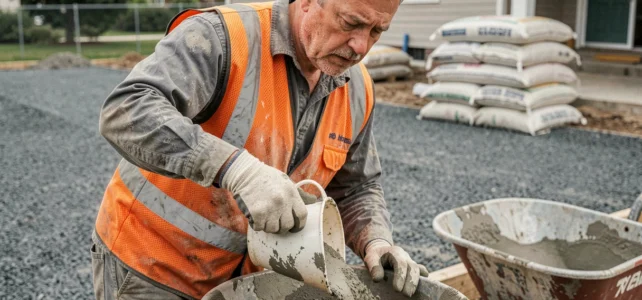
On a construction site for a terrace or garage, a failed slab is quickly noticeable: star-shaped cracks after the first winter, a crumbly surface that crumbles under the weight of a wheelbarrow. In almost all cases, the problem stems from the concrete mix, not from pouring or formwork. Mastering the proportions of cement, sand, gravel, and water before starting the concrete mixer is what separates a durable slab from a project that needs to be redone.
Water/cement ratio: the parameter that most tutorials underestimate
We often talk about the cement dosage per cubic meter, rarely about the ratio between water and cement. Yet, it is this ratio that determines the final strength and durability of the slab.
The NF EN 206+A2/CN standard, updated in December 2025, more strictly regulates this water/cement (W/C) ratio based on exposure classes. For a terrace slab exposed to frost (class XF1), a W/C ratio that is too high weakens the concrete much more than a slight under-dosage of cement. Too much water in the mixer makes the concrete fluid and easy to work with, but creates capillaries in the hardened mass. These micro-channels allow moisture to enter, which freezes and causes the surface to spall.
In practice, we aim for a W/C ratio of around 0.5 for a standard slab. This means that for every kilogram of cement, we add half a liter of water, no more. If the mix seems too dry, we adjust with half a bucket, never by emptying the hose into the concrete mixer. As detailed in articles on News Connect, this error of excess water is the most common on small domestic projects.
Concrete dosage for slabs: the 1-2-3 rule and its limitations on-site
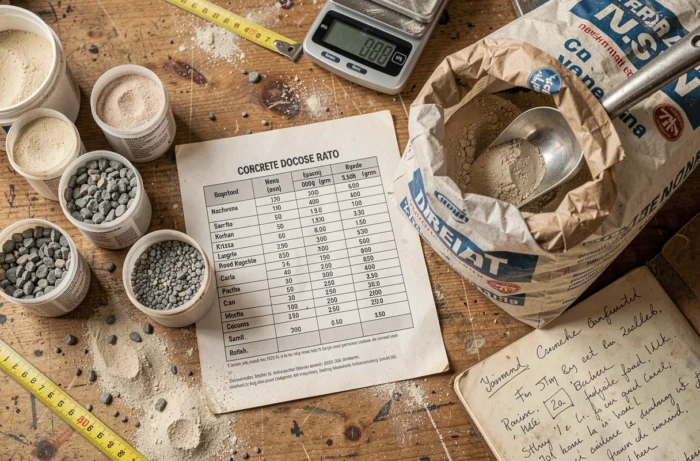
The basic rule found everywhere (1 volume of cement, 2 of sand, 3 of gravel) works as a starting point. When related to the cubic meter, it gives about 350 kg of cement, which corresponds to the standard dosage for common slabs and foundations.
On-site, this rule has concrete limitations.
- Sand does not always have the same grain size or moisture content. Wet river sand already contains water, which skews the W/C ratio if we do not reduce the water input accordingly.
- Gravel varies between 0/10, 0/14, and 0/20. For a classic slab (terrace, garden shed), a 0/20 mix is suitable. For a finer structure, a smaller aggregate provides better filling.
- Bucket dosages assume regular volumes. In reality, a flat shovel and a rounded shovel significantly change the proportions in a full batch.
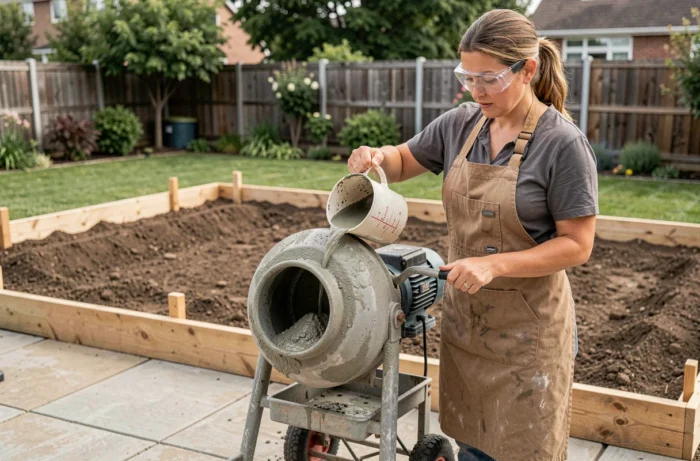
Measuring with a graduated bucket rather than a shovel reduces discrepancies. A standard mason’s bucket holds 10 or 12 liters: we know exactly how many volumes we incorporate into each batch.
Bucket dosage for a typical batch
To produce about 100 liters of concrete dosed at 350 kg/m³, we roughly count 1 bucket of cement, 2 buckets of sand, and 3 buckets of gravel, plus half a bucket of water, adjusting according to the moisture of the sand. Each batch must be dosed the same way, otherwise the slab will have areas of uneven strength that crack at the joints.
Cement overdosage: why more is not better
It is often believed that adding more cement strengthens the slab. This is false beyond a certain threshold. Concrete that is too rich in cement (beyond 400 kg/m³ for a standard slab) generates more significant drying shrinkage. This shrinkage causes shrinkage cracks, sometimes visible within the first few weeks.
The current trend in concrete formulation is moving towards minimal binder contents rather than safety overdosage. For common exposure classes (XC, XF1), a binder content of 260 to 300 kg/m³ may suffice if the water/cement ratio is respected and the implementation is careful. The dosage of 350 kg/m³ remains the reference for an individual making their concrete with a mixer, as it compensates for on-site dosage inaccuracies.
A mortar that is too rich in cement poses the same type of problem for screeds: site feedback shows that over-dosed screeds crack much more than those dosed just right. The principle is the same for a slab.
Calculating the volume of concrete and safety margin for a slab
The basic calculation is simple: length (in meters) x width x thickness. For a terrace slab of 4 m by 3 m with a thickness of 12 cm, this gives 4 x 3 x 0.12 = 1.44 m³.
This raw figure is never enough. We add a margin of 10% to account for ground irregularities, losses during wheelbarrow transport, and variations in thickness in the formwork. Therefore, our slab requires about 1.6 m³ of concrete to prepare.
Common errors in volume calculation
- Forgetting to convert thickness to meters (12 cm = 0.12 m, not 12 in the formula).
- Not accounting for the gravel bed under the slab, which can create voids to fill.
- Underestimating the volume when the formwork is not perfectly level, creating thick spots on one side.
Planning the 10% margin avoids stopping mid-pour, a dreaded situation because a resumption of pouring on hardened concrete creates a cold joint, a structural weak point in the slab.
Ready-mix concrete or on-site mixing: a choice that changes the dosage
Beyond one cubic meter, mixing with a concrete mixer becomes lengthy and physically demanding. Ready-mix concrete delivered by truck arrives with a controlled dosage at the plant, a mastered W/C ratio, and a consistency that manual mixing cannot match.
For small volumes (garden wall foundation, door threshold), on-site mixing remains relevant as long as the proportions are respected bucket by bucket. Feedback varies on this point, but the tipping point is generally around one cubic meter: below, we manage with a mixer; above, delivered concrete limits dosage errors and saves several hours of work.
For a project like a garage or terrace slab exceeding a few square meters, requesting a quote from a plant remains the most reliable solution to obtain concrete that meets strength and durability requirements, without risking an approximate dosage that will pay off during the first freeze-thaw cycle.