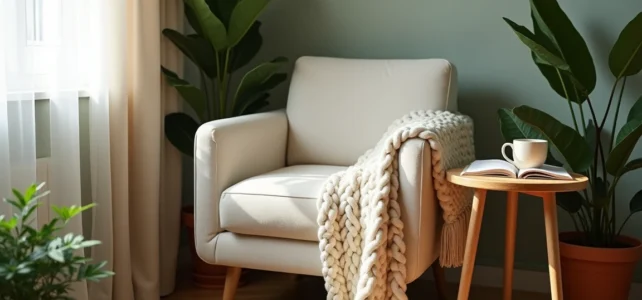
Home comfort relies on measurable parameters: wall radiant temperature, light spectrum, and levels of volatile organic compounds in the ambient air. Here, we discuss the technical levers that can sustainably transform your home into a true wellness space.
Indoor air quality and materials: the invisible foundation of well-being
The comfort perceived in a room primarily depends on what is not visible. Formaldehyde emissions condition air quality far more than the choice of an oil diffuser. Since January 1, 2023, French regulations have lowered the guideline value for formaldehyde in indoor air to 100 µg/m³ in the short term.
This threshold concretely modifies the selection of particle boards, carpet adhesives, and wall paints. We recommend systematically checking for the A+ emission class on each finishing product and favoring natural materials (solid wood, linen, hemp, terracotta) whose VOC emissions remain negligible after installation.
Ventilation plays a complementary role. A properly sized single-flow mechanical ventilation system renews the air without creating a noticeable draft. In the rooms where you spend the most time (bedroom, living room), an extraction rate suited to the volume reduces pollutant concentration and maintains a humidity level favorable to respiratory comfort. Additional resources on interior design are available on the website www.blog-vip.net dedicated to the home, which specifically addresses these technical subjects applied to housing.
Radiant temperature and real thermal comfort
The perceived temperature does not correspond to that displayed by the thermostat. It depends half on the radiant temperature of the walls. A poorly insulated wall at 14 °C in a room heated to 21 °C gives a sensation equivalent to 17.5 °C. Turning up the heating does not solve anything: it dries the air and increases the bill without correcting the discomfort.
The solution lies in insulating cold walls (interior lining, thermal corrective coating) or using a radiant heat emitter positioned facing the deficient wall. Air-water heat pumps, whose residential sales resumed in 2025 in most European countries according to the European Heat Pump Association, offer a double advantage: low-temperature heating via the floor (uniform radiation) and moderate summer cooling.
Choice of emitter according to the room
- Low-temperature underfloor heating in the living room and bedroom: uniform radiation without air mixing, compatible with wood or natural stone coverings.
- Inertia radiator in cast iron or stone in passage rooms (entrance, hallway): gradual temperature rise, gentle warmth persisting after shutdown.
- Towel warmer with heat transfer fluid in the bathroom: provides immediate comfort over a short time frame without overheating the rest of the home.
Zone control remains key. Each room has its own usage, schedule, and thermal need. A thermostat per zone prevents waste and maintains the exact comfort temperature where you are.
Light spectrum and circadian rhythm in the home space
Artificial lighting directly affects melatonin production and the wake-sleep cycle. A light that is too cold in the evening disrupts falling asleep, while a light that is too warm during the day reduces alertness. The cocoon of well-being comes from lighting suited to the times of day.
We recommend distinguishing three lighting layers per room:
- Functional light (worktop, desk): color temperature between 4,000 and 5,000 K, sustained intensity, directed towards the task.
- Ambient light (living room, bedroom in the evening): lamp at a maximum of 2,700 K, positioned indirectly (opaque lampshade, wall sconce directed towards the ceiling).
- Accent light (reading light, bedside lamp): low intensity, warm spectrum, accompanying the transition to sleep.
Dimmable lamps allow you to adjust the intensity without changing bulbs. A dimmer switch in the bedroom and living room is inexpensive and radically changes the cozy atmosphere at the end of the day.
Natural light and furniture arrangement
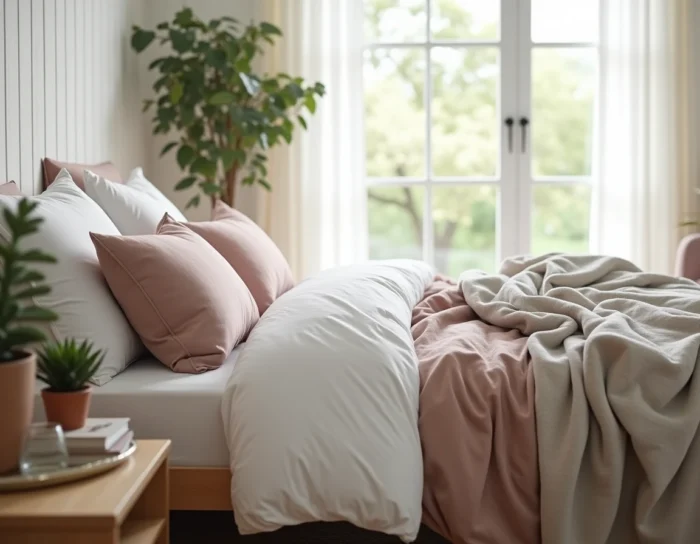
Before multiplying light fixtures, take advantage of natural light. The position of the bed, sofa, and desk relative to the windows determines exposure to the full solar spectrum. Placing the desk facing a north or east-oriented window offers stable light without glare. The bed benefits from being moved away from the main window to avoid early wake-ups in summer.
Light colors on the walls opposite the windows reflect light and increase perceived brightness without electrical addition. Saturated colors (deep blue, forest green) work better on the window wall, where they absorb excess light and create visual depth.
Domestic acoustics: the forgotten parameter of wellness decoration
A visually successful interior can remain uncomfortable if sound reverberation is excessive. Hard surfaces (tiles, polished concrete, glass) reflect sound and create insidious auditory fatigue, especially in open living spaces.
The ideal reverberation time in a living room is under one second. To achieve this without turning the room into a recording studio, three levers are sufficient: a thick rug on the floor, heavy curtains at the windows, and at least one bulky textile element (fabric sofa, upholstered armchair). Bookshelves filled with books also make excellent acoustic diffusers due to the irregularity of their surface.
In the bedroom, a headboard panel made of padded fabric or perforated wood reduces reflections behind the pillow. The effect on sleep quality is felt from the first nights, particularly in new homes where lightweight partitions transmit more noise.
Transforming your house into a cocoon of well-being is less about decoration and more about comfort engineering. Healthy air, tempered walls, calibrated light, controlled acoustics: each of these parameters affects the body before it affects the eye, and it is their joint treatment that makes the difference in daily life.