
Planning a successful event without stress involves measuring what separates smooth organization from chaotic management. The gaps rarely lie in the ambition of the project, but in the method applied at each stage, from the initial framing to the post-event debriefing. Here are ten concrete tips, listed in no particular order, to structure each phase of event planning.
1. Set a framing deadline before any bookings

Most delays in event organization stem from late framing. Setting a deadline to validate the format, capacity, and main message allows you to lock in structural decisions before contacting any service providers.
This framing includes the purpose of the event (launch, internal cohesion, celebration), the profile of the participants, and non-negotiable constraints (accessibility, timing, dietary restrictions). Without this step, each subsequent choice is based on vague assumptions, leading to increased back-and-forth and mental load.
To delve deeper into this initial phase, several tips for planning an event detail how to prioritize these foundational decisions.
2. Integrate the ISO 20121 standard as a decision-making framework

The ISO 20121 standard, revised in April 2024, structures the responsible management of an event throughout its entire cycle. It does not set rigid numerical targets but imposes a management methodology covering design, logistics, and debriefing.
Application feedback indicates a 20 to 40% reduction in carbon footprint for events that truly apply this framework. The benefit for stress-free planning is direct: the standard requires anticipating hidden costs, formalizing selection criteria for providers, and documenting each decision, which reduces last-minute surprises.
3. Build a retroplanning schedule with real safety margins
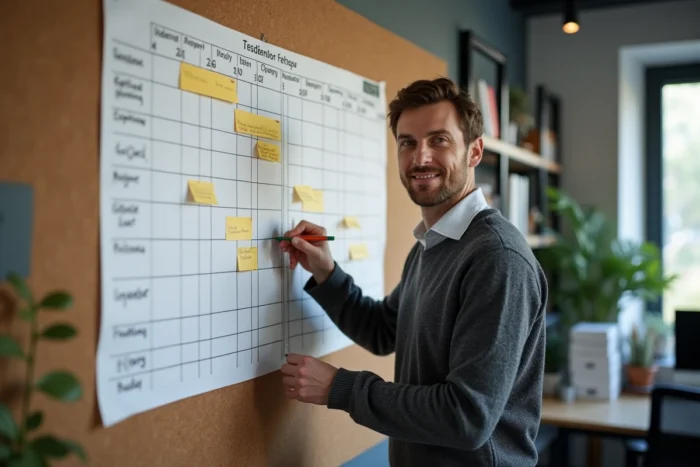
A retroplanning schedule without margins is a fictitious schedule. Each milestone (venue validation, caterer confirmation, invitation sending) must include a buffer of a few days to absorb supplier delays or last-minute changes.
| Phase | Recommended timeframe before D-day | Safety margin |
|---|---|---|
| Framing and objectives | 4 to 6 months | 2 weeks |
| Venue booking | 3 to 5 months | 1 week |
| Provider selection | 2 to 4 months | 2 weeks |
| Invitation sending | 6 to 8 weeks | 1 week |
| Technical rehearsal | 1 to 2 weeks | 2 days |
This type of table, adapted to each project, transforms the retroplanning into a management tool rather than just a list of dates.
4. Centralize all information in a single tool

Scattering information across emails, spreadsheets, messaging apps, and paper notes is the primary factor of organizational stress. A single centralization tool (collaborative spreadsheet, project management software, or dedicated platform) allows each participant to access the same data in real-time.
Recent event management tools incorporate automation features (reminders, confirmations, registration tracking) that reduce repetitive tasks. The gain is not only measured in time but in reliability: fewer duplicates, fewer oversights, fewer contradictory messages.
5. Negotiate provider contracts with clear cancellation clauses
A reliable provider is also recognized by the clarity of their cancellation and modification conditions. Before signing, check three concrete points:
- The cancellation deadline without penalty and the percentage retained thereafter
- The possibility of modifying the capacity or format without major additional costs
- The conditions for replacement in case of provider failure on D-day
These clauses protect the organizer against unforeseen events without turning each adjustment into a contractual conflict.
6. Define a budget with a reserve line for “unexpected” expenses

An event budget without an “unexpected” line is systematically exceeded. Planning a budget reserve dedicated to unanticipated expenses allows for absorbing additional costs (technical extras, weather changes for an outdoor event, replacement provider) without having to make urgent trade-offs.
This reserve is distinct from classic items (venue, catering, communication, technical). It is not a comfortable surplus: it represents the margin that separates controlled organization from ongoing crisis management.
7. Test technical logistics before D-day

Sound systems that crackle, incompatible projectors, saturated Wi-Fi connections: technical failures on D-day almost always result from a lack of prior testing. A technical rehearsal on-site, even brief, allows for identifying friction points before they become emergencies.
This rehearsal covers connectivity, network capacity, room acoustics, and electrical access. It is ideally scheduled one to two weeks before the event, with the relevant providers present.
8. Delegate with individual responsibility sheets

Delegating without a framework produces as much stress as not delegating at all. Each person involved in the organization should have a sheet outlining their responsibilities, direct contacts, and margins for autonomous decision-making.
This format avoids two common pitfalls: task duplication (two people managing the same issue unknowingly) and the void of responsibility (no one feels in charge of a critical point). The sheet is limited to one page, with concrete actions and deadlines.
9. Prepare a documented plan B for identified risks
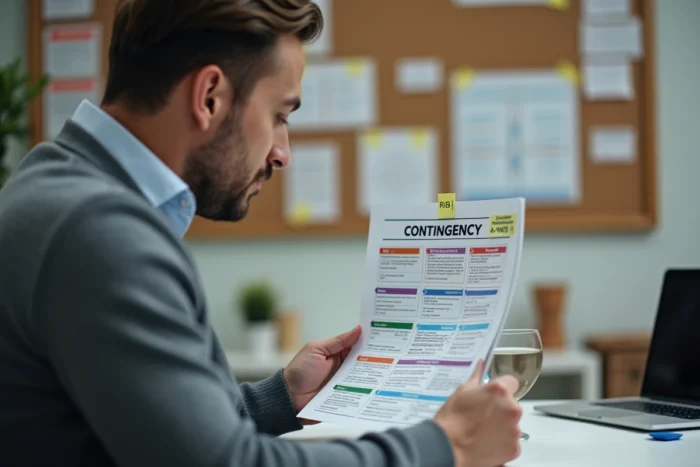
A mental plan B is not enough. The most frequent risks (provider cancellation, bad weather, under-attendance or over-attendance) must be the subject of a written and shared alternative scenario with the organizing team.
This document lists for each identified risk: the trigger, the planned alternative, the person responsible for activation, and any potential additional costs. It transforms crisis management into protocol execution, significantly reducing stress at the critical moment.
10. Schedule a structured debriefing in the days following the event

The post-event debriefing is the most neglected phase, even though it conditions the quality of subsequent events. Scheduling it in the days following (not weeks later) ensures that feedback is still fresh and actionable.
A structured debriefing covers three areas:
- What worked and why (to replicate it)
- What posed a problem and the identified cause (to correct it)
- Concrete improvement suggestions, with a designated responsible person for each action
This documented and archived feedback becomes a directly reusable resource. Organizing a successful event does not end when the last guests leave, but when the lessons learned are formalized for the future.