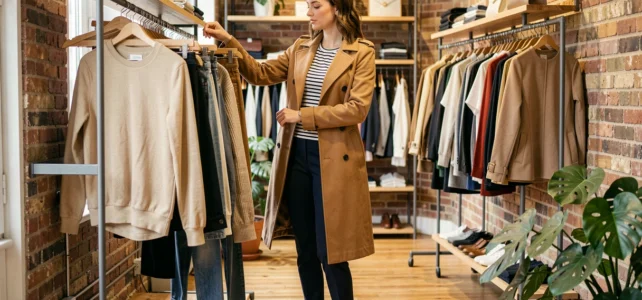
Clothing sales in France have contracted in recent years, and the annual purchase frequency per household has significantly declined compared to pre-Covid levels. Embracing fashion daily no longer means accumulating pieces each season. The context pushes towards a more streamlined wardrobe, where each garment must justify its place through versatility and durability.
Anti-fast fashion law in France: what changes for everyday shopping
France has adopted a law against fast fashion, with penalties coming into effect in September 2026. This legislation directly targets ultra-fast fashion brands by imposing surcharges on products that are very low-priced and have a high environmental impact. For consumers who build their style daily, this law concretely alters the price equation.
The cheapest pieces on the market are seeing their costs rise, which reduces the price gap with higher-quality clothing. This partial price leveling encourages a different trade-off: instead of buying five bottom-priced t-shirts, it becomes financially sensible to choose two made from more durable materials.
Following fashion with Maison de Mode allows for identifying pieces that last several seasons without losing style, a reflex that aligns with this new regulatory landscape.
The European Union is also working on a circular fashion strategy and a digital product passport, which would require brands to display the traceability and exact composition of each garment. Transparency about materials becomes a concrete purchasing criterion, not just a marketing argument.

Second-hand and slow wardrobe rotation: the true driver of daily style
Second-hand is no longer a parallel market reserved for vintage enthusiasts. It has become a structural channel for dressing daily. The Syndex report on clothing highlights that the search for the best value for money strongly promotes the development of second-hand.
This shift changes the way a look is constructed. Instead of seeking the latest trend in stores, a growing share of buyers starts by scouring resale platforms to find a specific piece: a trench coat, a structured blazer, a pair of raw jeans. Second-hand imposes a logic of targeted searching rather than impulsive buying.
The advantage for daily style is twofold. On one hand, second-hand pieces often come from higher ranges than what the buyer would have chosen at full price. On the other hand, a wardrobe gradually built from second-hand finds naturally has more character than a wardrobe purchased in a single session from the same brand.
What slow rotation changes in piece choices
When buying less, each addition carries more weight. Field reports show that consumers who space out their purchases prioritize three criteria:
- Compatibility with already owned pieces, to multiply combinations without multiplying clothing
- Quality of finishes (stitching, buttonholes, lining), because a piece worn often wears out quickly if poorly assembled
- Relative neutrality of the cut, which allows for crossing several seasons without becoming outdated
A garment worn twice a week for two years costs less per wear than a trendy purchase relegated to the closet after three months. This calculation, increasingly internalized, redefines what it means to “follow fashion.”
Seasonal colors and materials: filtering lasting trends
Fashion shows and social media present dozens of micro-trends each season. The problem for daily style is not a lack of inspiration, but excess. Not everything deserves to be adopted, and data from the Lyst Index confirms that only a few trends per season generate sustainable search interest.
For autumn-winter, the colors that regularly appear in searches are earthy tones (camel, brown, rust) and deep shades (burgundy, forest green). These hues work because they easily combine with each other and with the black or gray basics already present in most wardrobes.
Materials matter more than colors for the longevity of a garment. A dense blended wool sweater will last through winter without pilling, whereas a fine acrylic sweater will lose its shape after a few washes. In spring, linen and thick cotton offer a drape that lightweight synthetic materials cannot replicate.
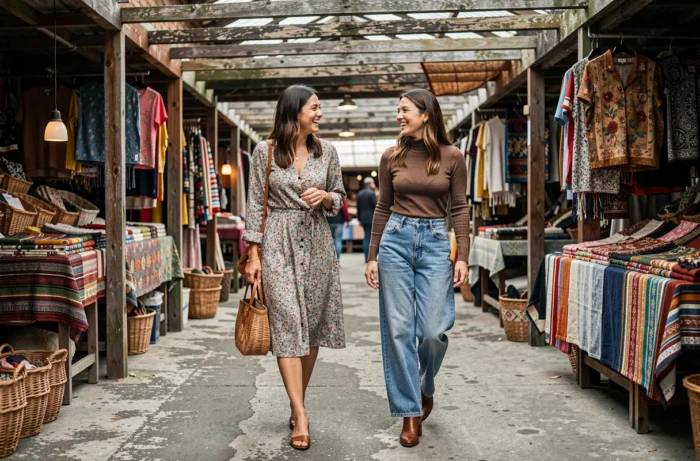
Three filters to evaluate a trend before buying
- Has the trend existed for at least two consecutive seasons in online searches? If so, it has surpassed the stage of fleeting buzz
- Can the piece be worn with at least three outfits already in your closet? If the answer is no, it will remain isolated
- Is the cost per wear (purchase price divided by the estimated number of times you will wear it) reasonable? This calculation eliminates pure novelty purchases
Building a daily look without relying on seasonal trends
Daily fashion works best when it rests on a stable foundation. A few well-chosen pieces (a pair of jeans tailored to your body type, a neutral blazer, a versatile pair of shoes) form a base upon which seasonal touches can effortlessly attach.
Daily style is built through subtraction, not accumulation. Removing a piece that no longer works frees up mental and physical space. Field reports vary on the ideal number of pieces in a functional wardrobe, but the principle remains the same: each garment must fit into at least two different outfits.
Fashion trends then serve as accents, not structure. An accessory in the season’s color, a material that adds texture, a slightly updated cut is enough to give a sense of renewal. Embracing daily fashion means adjusting details on a mastered base, not starting from scratch every autumn or spring.
The regulatory context, the rise of second-hand, and the decrease in purchase volumes shape a more demanding relationship with clothing. Daily style gains coherence, provided one accepts that renewal comes through the precision of choices rather than their quantity.