
The majority of photographers who consult us discover their coverage gaps after an incident. Choosing insurance to protect a camera relies less on the premium price than on a careful reading of the exclusion clauses, the contractual definition of theft, and the geographical scope of the coverage.
Theft clause without break-in: the contractual trap to decipher before any subscription
Insurance contracts distinguish several categories of theft, and this distinction conditions reimbursement. Theft with break-in (forced entry at home, broken vehicle) is covered by almost all policies. Theft by pickpocketing or snatching, however, is explicitly excluded from basic contracts in most current French offers.
This is a major blind spot. A camera stolen from an open bag on a terrace, a lens taken from a tripod during an outdoor shoot: these scenarios, among the most common for valuable equipment, do not trigger any compensation under a standard contract.
We recommend checking three specific points in the special conditions:
- The exact definition of the word “theft” retained by the insurer (characterized break-in, aggression, simple theft)
- The proof conditions required: filing a complaint within 24 hours, declaration within two working days, providing the serial number and the purchase invoice
- The compensation limits applied outside the home, often much lower than the overall limit of the contract
Finding the best camera insurance first requires understanding what the contract does not cover, rather than what it promises in large print.
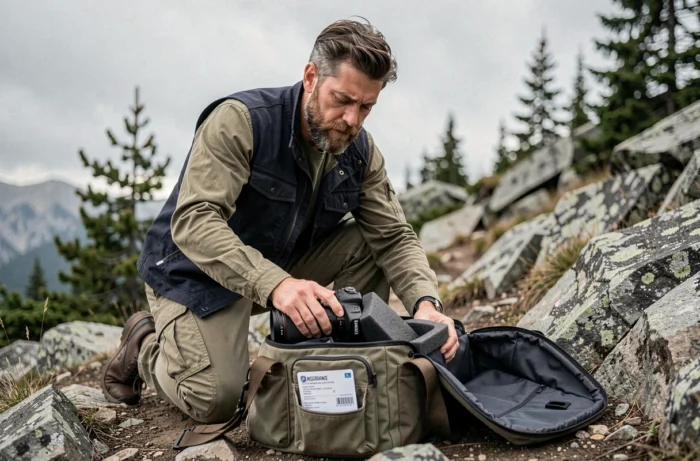
Home extension or dedicated contract: mapping existing coverage
Recent offers in France favor complementary modules attached to multi-risk home insurance rather than isolated “portable device” policies. These extensions typically cover accidental damage and theft outside the home, with a global limit and strict justifications.
Before subscribing to an additional contract, we observe that it is essential to audit what the home already offers. Many photographers unknowingly pay twice for the same guarantees.
What home insurance generally covers
The multi-risk home contract protects photo equipment against fire, water damage, and theft with break-in at home. Some contracts include a “valuable items” or “high-tech” option that extends coverage outside the home.
What a dedicated contract adds
A specific “camera” or “portable devices” contract targets accidental damage outside the home, oxidation, and sometimes loss. Oxidation is rarely covered by home insurance, while it poses a real risk for any photographer working outdoors (sea spray, rain, tropical humidity).
The duplication trap is financial but also procedural: in the event of a claim covered by two contracts simultaneously, the total compensation never exceeds the value of the item. Paying two premiums for a single reimbursement makes no sense.
Amateur, semi-pro, or professional equipment: distinct contractual requirements
The differentiation between amateur, semi-professional, and professional photographers is becoming more pronounced in insurance offers. A photographer who charges for services cannot settle for public coverage.
Professional use requires professional photographer liability insurance in addition to equipment insurance. This professional liability covers damages caused to third parties during the exercise (studio equipment damaged at a client’s place, injury during a shoot). Equipment insurance alone only protects the photographer against their own losses.
For an amateur, the calculation is different. The value of the lens collection often exceeds that of the camera body. We recommend listing each item (camera body, lenses, flash, tripod, potential drone) with its purchase value and checking that the contract limit covers the entire kit, not just the most expensive item.
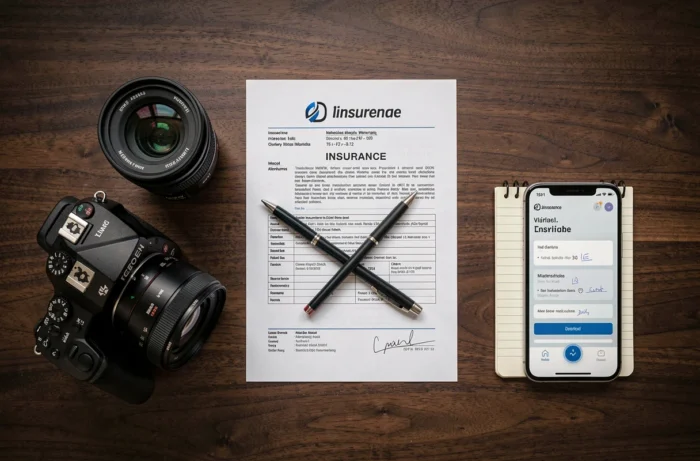
Criteria for selecting camera insurance: a technical reading grid
Comparing offers solely based on the monthly premium amount is akin to comparing camera bodies solely on their megapixel count. The grid below allows for a more rigorous analysis.
- Geographical scope: some contracts limit coverage to the national territory, excluding any reporting abroad
- Deductible per claim: a high deductible can make insurance useless for mid-range equipment
- Valuation method: compensation at replacement value, new value, or with depreciation deducted (the difference can represent half the price of a lens after a few years)
- Waiting period: some policies impose a waiting period before activation, sometimes several weeks
- Number of annual claims covered: a limit of one claim per year makes coverage fragile for intensive use
The valuation method deserves particular attention. An item compensated with depreciation deducted loses half its value in a few years. For professional equipment that is frequently renewed, new value is justified. For an amateur who keeps their camera body for a long time, replacement value offers a better compromise.
A final technical point often overlooked: coverage of accessories. Memory cards, batteries, filters, and carrying bags are rarely included in entry-level policies. Checking their explicit mention in the contract avoids an unpleasant surprise at the time of the claim.
The choice of camera insurance hinges on contractual definitions, not commercial promises. Reading exclusions before guarantees remains the only reliable method to protect a gear collection, regardless of the level of practice.