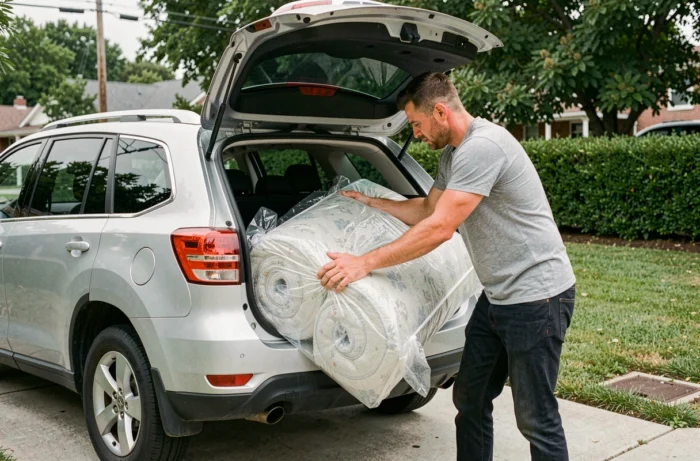
A rolled mattress that doesn’t fit in the trunk, a back seat that’s too short, straps that can’t be found at the last minute: this scenario is classic during a move or a simple purchase at a store. The good news is that transporting a rolled mattress in a car doesn’t require a van. However, you need to know a few practical techniques to avoid damaging the foam or obstructing driving.
Rolled mattress in a car: it all depends on the type of foam
Before loading anything, check the composition of your mattress. A foam mattress (polyurethane foam, memory foam, or latex) can be rolled without major structural risk. The foam gradually regains its shape once unrolled.
A pocket spring mattress, on the other hand, cannot be rolled. The metal springs deform under the pressure of rolling and do not return to their original position. If your mattress contains springs, transporting it flat in a van remains the only reliable option.
You will find transport tips on Idylle Habitat that also detail precautions based on the mattress composition.
Why is this distinction so important? Because a poorly rolled mattress loses its supportive properties. Only foam mattresses can withstand rolling, and even then, it’s best not to leave them compressed for more than a few days.
Vacuum bag and rolling: the method to compress a mattress at home
Box mattress manufacturers use industrial machines to compress their products. You can partially replicate this process with a vacuum compression bag designed for bedding.
Steps for rolling with a vacuum bag
- Remove all bedding (sheet, mattress protector, topper) and lay the mattress flat on the floor in a clean room.
- Slide the mattress into the reinforced bag, seal it tightly, and then vacuum out the air with a powerful vacuum until the volume decreases significantly.
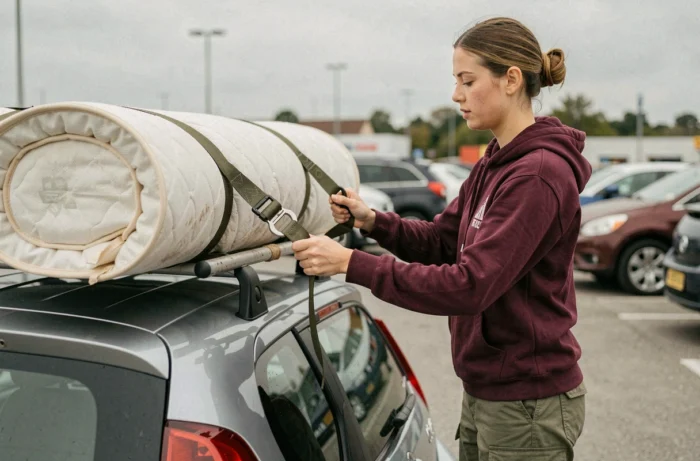
- Roll the compressed mattress from one end while pushing out any residual air, then secure it tightly with two or three ratchet straps.
The vacuum bag dramatically reduces the volume of a foam mattress, sometimes enough for it to fit in a sedan trunk. Without a bag, simple rolling also works, but the mattress will remain bulkier and harder to secure.
Where to find these bags
Compression bags for mattresses can be found at large DIY stores or online. Choose a model suitable for the size of your mattress (single, double, queen). A bag that is too small will tear under tension, making the operation pointless.
Preparing the vehicle interior before loading
A rolled mattress should not be thrown in the back of the car. The interior space must be arranged so that the mattress is stable and the driver’s visibility remains clear.
Fully fold down the back seats to create a flat surface. On most sedans and SUVs, this maneuver frees up enough space for a rolled single mattress. For a double mattress, you will often need to use the front passenger seat as well, folded down as much as possible.
Have you thought about the ski hatch? This small passage between the back seats and the trunk, present on many models, allows you to slide a tightly rolled mattress diagonally. The mattress extends into the cabin but remains contained.
Protect the car’s upholstery with a blanket or an old sheet. The plastic cover of the mattress can rub and mark the seat trims during the journey, especially on turns.

Securing and road safety: preventing the mattress from moving during transit
A poorly secured mattress slides during each braking. It can block the gear lever, obstruct the rearview mirror, or shift against the driver. This is not a detail: it’s a risk of accident.
- Use at least two ratchet straps to secure the mattress to the anchor points in the trunk or to the folded headrests.
- Place heavy but stable objects (boxes, suitcases) on either side of the mattress to limit lateral movement.
- If the mattress extends into the cabin, check that the rearview mirror provides adequate visibility. If not, adjust your side mirrors more widely.
Never transport a mattress on the roof of a car without an appropriate roof rack. Even though this practice is not prohibited per se, specialized guides strongly advise against it: wind resistance can cause it to detach at high speeds, and exposure to rain or UV rays deteriorates the foam.
Protecting the mattress during transport with an appropriate cover
The compression bag already partially protects the mattress, but it is not designed to withstand prolonged friction. A mattress protection cover, sold at large retailers or bedding specialists, adds a barrier against dust, moisture, and snags.
If you don’t have a cover, wrap the mattress in stretch film in several layers. Overlap at least three passes of film to ensure the protection holds. This improvised solution works well for a short trip.
Avoid using cut and taped garbage bags. They tear at the first handling and leave the mattress exposed to dirt in the trunk.
Upon unloading
Unroll the mattress in the destination room as soon as you arrive. The longer a foam mattress remains compressed, the longer it takes to regain its original thickness. Let it regain its shape for at least a few hours before sleeping on it.
Transporting a rolled mattress in a car remains a simple operation as long as you adhere to two principles: only compress a foam mattress, and secure the roll firmly in the cabin. With a vacuum bag, straps, and a well-prepared trunk, even a small car can suffice for a single mattress.