The Palais-Royal theater has just over 700 seats spread across several levels: orchestra, box, and balcony. Each area offers a different experience in terms of visibility, acoustics, and pricing. Before booking your seat at the Palais-Royal theater, understanding what each category concretely offers helps avoid unpleasant surprises, especially in an Italian-style auditorium where the historical architecture creates marked disparities from one seat to another.
Pricing by category at the Palais-Royal theater: what the price gap reveals
To provide a concrete basis, here are the price ranges observed in a recent program (show “Du Charbon dans les Veines”, season 2026):
| Category | Price Range | Associated Area |
|---|---|---|
| 1st category | Up to 59 € | Central orchestra, front box |
| 2nd category | About 35 to 45 € | Side orchestra, side box |
| 3rd category | From 20 € | Balcony, last rows of the orchestra |
The gap between the cheapest and the most expensive seat is therefore nearly threefold. The question is whether this gap is consistently justified by a proportional gain in comfort.
In the first category, the central rows of the orchestra offer a direct line of sight to the stage. However, some side seats sold at the same price have a reduced viewing angle due to the horseshoe layout of the auditorium. The seating plan alone is not enough to identify these differences.
To know how to choose the best seat at the Palais-Royal theater, one must cross-reference the seating plan with the configuration of the show, as the staging does not always utilize the entire stage.
Visibility and blind spots: comparing orchestra, box, and balcony
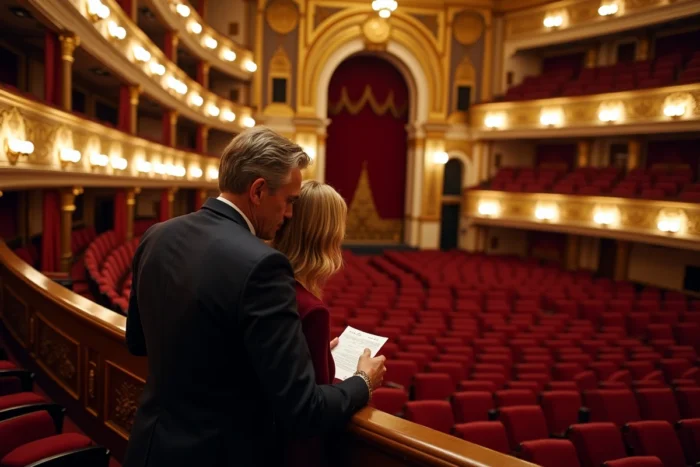
The Italian-style auditorium of the Palais-Royal dates back to 1784. Its geometry creates constraints that modern theaters do not have. Two parameters weigh heavily: the presence of load-bearing pillars between the orchestra and the box, and the vertical offset between the levels.
Orchestra: proximity versus neck comfort
The first three or four rows place the spectator very close to the actors. The immersion is maximum, but the gaze must be constantly raised if the staging uses elevated platforms. At the ends of these rows, the field of vision does not cover the entire width of the stage.
The central rows (approximately fifth to tenth) offer the best compromise. The view encompasses the entire stage effortlessly. This is also the most contested area during busy evenings.
Box: the elevated viewpoint
The box overlooks the orchestra and provides a bird’s eye view that reveals the entire set. The seats facing the stage rival the best in the orchestra, often for a slightly lower price. However, the side seats in the box require a torso rotation to follow the action on the opposite side.
Balcony: the value-for-money ratio to be nuanced
The balcony offers the most accessible prices. The distance from the stage is real, but the view remains clear from the central seats. The expressions of the actors become less readable, which can be a drawback for a play that relies heavily on facial expressions. For a comedy with a broad staging or a musical show, the central balcony remains a relevant choice for a small budget.
Lighting effects and visual comfort: a recent parameter to consider
The decree of June 18, 2026, now allows the use of class 3R lasers in areas occupied by the public in performance venues, provided that the IEC60825 standard is respected. This regulatory evolution changes the game for seat selection in certain productions.
Shows that incorporate laser effects often direct these beams towards the front rows and balconies. If you are sensitive to glare or wear progressive lenses, the middle rows of the orchestra or the central box limit direct exposure.
This parameter does not apply to all plays scheduled at the Palais-Royal, but it deserves verification at the time of booking, especially for shows with a strong visual component.
Room acoustics and placement: where the sound arrives best
An Italian-style auditorium concentrates sound towards the center of the curve. Seats located in the median axis of the orchestra and box receive direct sound, without excessive reverberation. Side seats, close to the walls, capture more reflections, which can muddle the diction in unamplified plays.
French regulations on amplified music impose sound level ceilings in ERP. In practice, this means that amplified shows at the Palais-Royal remain calibrated for homogeneous auditory comfort, but seats under the overhang of the box lose clarity due to masking effects.
- Central orchestra (rows 5 to 10): best balance between direct sound and natural reverberation of the room
- Front box: sound slightly attenuated by distance, but good intelligibility thanks to the clear angle
- Balcony: perceived volume lower, compensated in amplified shows, less comfortable for spoken theater
- Seats under overhang (last rows of orchestra): sound muffled by the low ceiling, to be avoided if acoustics are a priority
The Palais-Royal theater remains a human-sized venue where no seat is truly bad. The price gap between categories mainly reflects a difference in visual comfort and immersion, not a qualitative chasm. For an occasional evening, the central box offers the best ratio between price, view, and acoustics. For enthusiasts who want to capture every actor’s expression, the central orchestra between the fifth and tenth row remains the reference.