
Béatrice Vonderweidt is often presented as a former model turned painter. This narrative, echoed by several online publications, is based on a rarely questioned observation: what public traces actually document each step of this journey? Between a career in fashion for which no professional photographic archive is publicly indexed and an artistic practice evidenced by a few identifiable exhibitions, Béatrice Vonderweidt’s profile invites us to measure the gap between biographical narrative and verifiable evidence.
Documented Exhibitions of Béatrice Vonderweidt: What Public Traces Allow Us to Verify
Most articles dedicated to Béatrice Vonderweidt mention an artistic journey without providing a precise timeline. Two events stand out from the consulted sources with identifiable geographical and temporal anchors.
| Exhibition | Location | Year | Type of Trace |
|---|---|---|---|
| Regards croisés | Institut français de Tel-Aviv | 2008 | Mention in several secondary sources |
| Lumière et présences | Caprice Gallery, Tel-Aviv | 2016 | Listing in art directories |
These two events constitute the strongest support points to document a painter’s activity. Eight years separate the two identified exhibitions, which leaves a considerable documentary gap.
Outside of these two milestones, no French gallery, no contemporary art fair, or any exhibition appears in the accessible search results. The anchoring in Tel Aviv, rather than in Paris or another French city, distinguishes this journey from the usual trajectories of artists coming from the fashion industry in France.
To better understand Béatrice Vonderweidt’s journey between modeling and painting, one must accept that the available sources paint an incomplete picture, where each verified element counts even more.
Untraceable Modeling Archives: A Narrative Based More on Repetition Than on Evidence
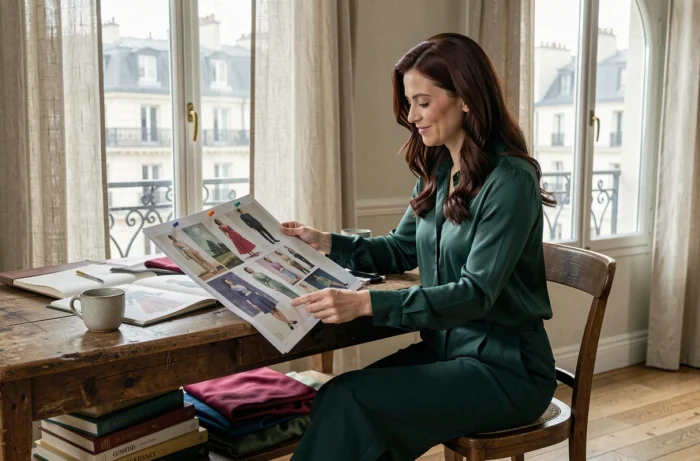
The fashion aspect of Béatrice Vonderweidt’s journey poses a symmetrical documentary problem. Several publications claim that she worked as a model, but no modeling archive is publicly indexed.
No online portfolio, no referenced advertising campaign, no mention in the archives of fashion houses or modeling agencies. This observation does not mean that the career did not exist. It means that the narrative “from modeling to painting” circulates without a reader being able to verify the first part independently.
This phenomenon is not unique to Béatrice Vonderweidt. Before the massive digitization of fashion archives, many modeling careers from the 1980s and 1990s left no accessible trace online. However, the repetition of the same biographical narrative from one article to another, often with very similar phrasing, creates an impression of consensus that does not rest on distinct primary sources.
High-Society Biography or Artistic Recognition: The Gray Area
The question at hand goes beyond the individual case. When a journey is told exclusively by online media without access to primary sources (in-depth interviews, exhibition catalogs, signed art critiques), the biographical narrative replaces artistic documentation.
Competing articles almost all follow the same storyline: modeling, transition, painting, discreet private life. This narrative structure works because it corresponds to an expected pattern. It does not currently allow for situating Béatrice Vonderweidt’s painted work within a movement, technique, or market.
Béatrice Vonderweidt the Painter: The Criteria That Distinguish Media Visibility from Artistic Recognition
To evaluate a painter’s journey, several markers are usually observable. Their presence or absence in the case of Béatrice Vonderweidt sheds light on the nature of her current visibility.
- Exhibitions in identifiable galleries or institutions, with an associated catalog or critical text. Two events in Tel Aviv are documented, none in France in the accessible sources.
- Presence on online art sales platforms (Artsy, Artnet, Saatchi Art) or in artist databases. No profile appears in the consulted results.
- Reviews or mentions in specialized press (Beaux Arts Magazine, Art Press, The Art Newspaper). No identified mention.
- Valuation or results in auction sales. No available data.
The absence of these markers does not disqualify an artistic practice. Many painters exhibit in private circles or sell directly without going through the institutional circuit. This reality concerns tens of thousands of artists in France.
What distinguishes Béatrice Vonderweidt’s case is the contrast between relatively dense online media coverage (several dedicated articles, publications on social media) and a near absence of traces in the contemporary art circuit.
Double Nominal Identity and Continuity of the Journey
One element rarely exploited by existing publications concerns the use of the name “Béatrice Goldnadel” alongside “Béatrice Vonderweidt.” This dual nominal identity appears consistently in sources, notably on a Pinterest profile under the name Beatrice Goldnadel Vonderweidt.
This nominal continuity allows for linking scattered traces: artistic activities under one name, public life under another. For platforms and search engines, two nominal identities fragment online visibility instead of consolidating it.
An artist whose exhibitions, sales, and publications are indexed under two different names will mechanically see their digital presence diluted. This technical factor, rarely mentioned, helps explain why the accessible documentation remains patchy.
Fashion and Painting in France: A Frequently Told Passage, Rarely Measured
The narrative of the transition from fashion to art benefits from a strong narrative appeal. Several French personalities have followed a similar path, with varying levels of documentation.
What is lacking in the case of Béatrice Vonderweidt, as in many similar profiles, is an element that allows for moving from narrative to evaluation: an accessible corpus of works, critical texts, public sale prices. Without these elements, the boundary between high-society biography and artistic career remains porous.
The available sources allow us to affirm that Béatrice Vonderweidt has exhibited in Tel Aviv at least twice, that she is publicly associated with a painting practice, and that her previous journey in fashion remains documentary unverifiable online. The rest is, for now, a narrative waiting for its evidence.