
A mobile home, under French law, is classified as a mobile leisure residence (RML). This classification radically changes the nature of administrative formalities: unlike a motorhome or a towed caravan, the mobile home is not subject to the same registration rules as a motor vehicle. Understanding this distinction helps avoid unnecessary procedures and focus on those that are truly mandatory.
Registration certificate and mobile home: what road law says
The registration certificate (formerly known as the gray card) applies to motor vehicles and trailers with a total authorized weight exceeding 500 kg. A mobile home, once placed on its plot, does not move autonomously on public roads. It does not have an engine.
The confusion arises from the wheeled chassis. The mobile home retains its means of mobility (wheels, axles) to legally remain an RML. However, this theoretical mobility does not transform it into a vehicle in the sense of the road code. The mobile home itself does not require a gray card.
On the other hand, the towing vehicle used to move the mobile home to its location must have its own valid registration certificate. If the transport is entrusted to an exceptional convoy (a common case given the dimensions), it is the transporter who manages the circulation authorizations. The procedures for registering a mobile home therefore focus less on the mobile home itself and more on the vehicles and trailers associated with its transport.
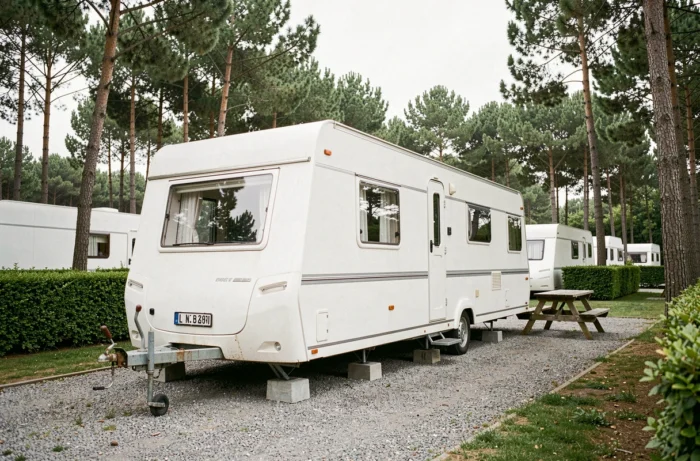
Declaration at the town hall and registration: the real formalities of the mobile home
Since the mobile home escapes classic registration, administrative procedures focus on its installation site and usage.
Placement on an authorized plot
The installation of a mobile home is legally restricted to classified campsites, Residential Leisure Parks (PRL), and holiday villages. Placing it on an unclassified private plot, even if buildable, exposes one to sanctions under the urban planning code. The ALUR law has reinforced this framework by strictly regulating light habitats and mobile residences.
Before any installation, the manager of the campsite or PRL provides a plot rental contract. This document specifies the duration, termination conditions, and maintenance obligations. Without a plot contract, no legal installation is possible.
Operation as furnished tourist accommodation
When a mobile home is rented out seasonally, it falls into the category of furnished tourist accommodations. The Le Meur law of November 19, 2024, has strengthened this regulation starting January 1, 2025. An registration number with the town hall will gradually become mandatory and must appear on each rental advertisement.
According to Service-Public, the registration obligation will become national through an online service planned for the fourth quarter of 2026. This number will replace disparate local declarations and standardize the monitoring of tourist rentals across the entire territory.
Documents and insurance: the file to be prepared for a mobile home
The absence of a gray card does not mean the absence of paperwork. A mobile home owner must gather several documents to be compliant.
- The purchase invoice or transfer certificate, which proves ownership of the property and mentions the manufacturer, model, and chassis serial number.
- The signed plot rental contract with the campsite or PRL, necessary to justify the installation location.
- A certificate of insurance covering at least civil liability, damage to the mobile home, and risks related to weather events on the plot.
- If applicable, the receipt of declaration at the town hall if the mobile home is operated as seasonal rental (furnished tourist accommodation).
Insurance deserves special attention. Unlike a vehicle, the mobile home is not subject to mandatory automobile insurance. It is closer to home insurance, with adapted coverage: fire, water damage, theft, natural disaster. Comparing specific “mobile home” contracts rather than taking out a standard multi-risk home insurance allows for better-calibrated guarantees.
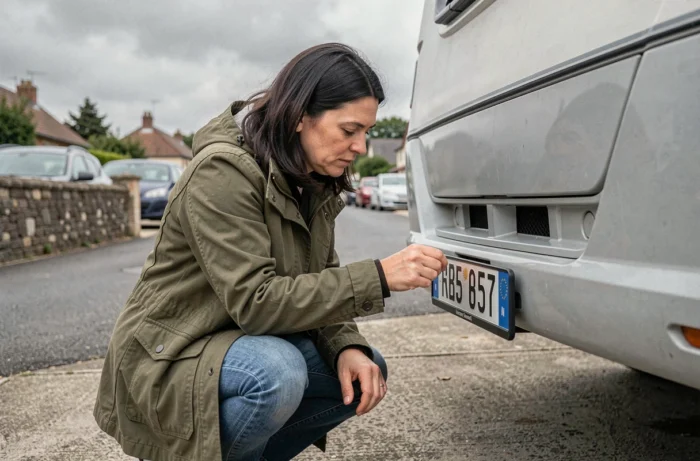
Trailer and convoy: when registration really comes into play
The only case where a mobile home owner faces a registration procedure concerns transport. If the mobile home is moved on a trailer exceeding 500 kg of total authorized weight, that trailer must have its own registration certificate.
The request is made via the ANTS (National Agency for Secure Titles) website. The required documents are the Cerfa registration application form, proof of residence of the holder, an identity document, and the trailer’s certificate of conformity. The cost depends on the fiscal power and the region.
For large mobile homes, transport often requires an exceptional convoy with a prefectural authorization. In this case, the owner does not directly manage the registration of the transport vehicle: it is the specialized company that holds the necessary authorizations and insurances.
Since 2026, the gray card can be dematerialized on a smartphone via France Identité, simplifying proof of registration for the towing vehicle or trailer during a road check while convoying.
The distinction between the mobile home (non-registered movable property) and the vehicles that move it (subject to registration certificate) remains the starting point for any procedure. Confusing the two leads to rejected requests or unnecessary costs. The file to be prepared ultimately boils down to proof of ownership, the plot contract, appropriate insurance, and if applicable, the declaration at the town hall for seasonal rental.