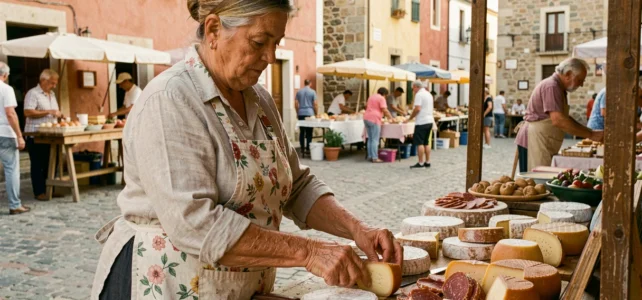
The markets in northern Sardinia do not operate like those on the Italian mainland. Their schedule, composition, and regulatory framework follow their own logic, linked to tourist seasonality, the fragmented geography of Gallura, and recent Italian legislative developments. Understanding these mechanisms allows one to distinguish a true producers’ market from a simple reseller fair.
Law 61/2022 and reserved spaces: what changes in Sardinian markets
Since the adoption of Italian Law No. 61/2022, municipalities are required to reserve a portion of their market spaces for agricultural producers (imprenditori agricoli) as well as professionals in fishing and aquaculture. This national provision also applies to municipalities in northern Sardinia.
The stated goal is to limit the presence of resellers, those merchants who buy in bulk and sell at stalls without a direct link to local production. Before this law, some weekly markets could be dominated by textile, bazaar, or imported food stalls, to the detriment of Sardinian producers.
Discussions about the practical implementation of this regulation continue within Italian legal and administrative communities. Field reports vary on this point: not all municipalities are yet applying these quotas with the same rigor, and the actual share reserved for producers varies from market to market. For those looking to explore market days in northern Sardinia, this distinction between producers’ markets and mixed markets is worth checking on-site.
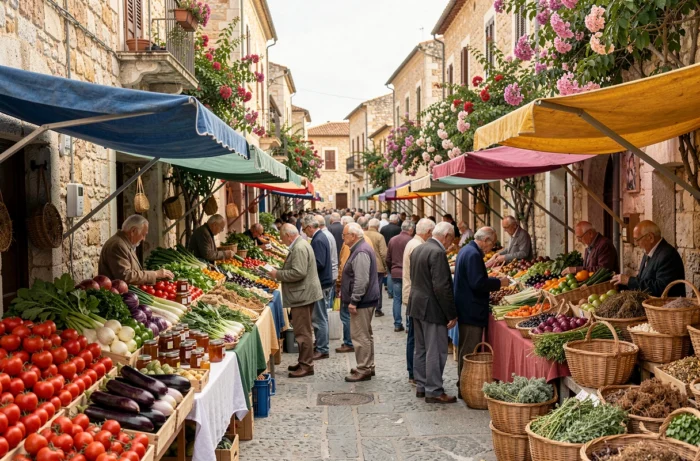
Campagna Amica markets in northern Sardinia: a label to look for
The Campagna Amica network, supported by the Fondazione Campagna Amica and Coldiretti, serves as a reliable marker for identifying authentic producers’ markets. These labeled markets guarantee a short supply chain: each seller is the direct producer of what they offer.
In northern Sardinia, the city of Alghero hosts a Campagna Amica market documented by the municipality itself. The official communication from the network highlights a continuous presence throughout the summer season, with an interesting feature: health prevention and food education campaigns are directly integrated into the markets. These initiatives, nationally promoted by Coldiretti as part of the “Notti Gialle,” transform the market into a space that goes beyond mere commercial transactions.
Spotting the Campagna Amica logo at a Sardinian market guarantees that the stalls of cheeses, cured meats, or vegetables come from local farms. Conversely, the absence of this label does not mean the market lacks interest, but rather that traceability then relies on direct trust with the seller.
Olbia, Tempio Pausania, Alghero: geography and calendar of markets
Northern Sardinia covers a vast territory, from the eastern coast around Olbia to the western front of Alghero, passing through inland villages like Tempio Pausania or Calangianus. Markets do not concentrate on a single day or a single location.
In Olbia, the Saturday market serves as the main weekly gathering. The city also hosts occasional events like the Akra Market, which takes over the city center with stalls combining crafts and local products. The Mercato Contadino at the Olbia Community Hub takes place regularly and specifically targets agricultural products from Gallura.
San Pantaleo, a small village located between Olbia and Arzachena, hosts a market with a distinct reputation: focused on crafts and artistic creations, it attracts a clientele different from that of traditional food markets. The products found there (ceramics, fabrics, wooden objects) lean more towards artisanal craftsmanship than gastronomy.
Evening markets in the summer season
During the summer, several coastal towns organize evening markets. These nighttime gatherings respond to a simple climatic logic: daytime temperatures make strolling uncomfortable. Cannigione, Palau, and other seaside resorts along the northern coast schedule these evening markets between June and September.
The summer calendar does not always align with the annual calendar. A market that takes place on a Tuesday in July may not exist in November. Checking with local tourist offices or municipal websites remains the safest method to avoid unnecessary trips.
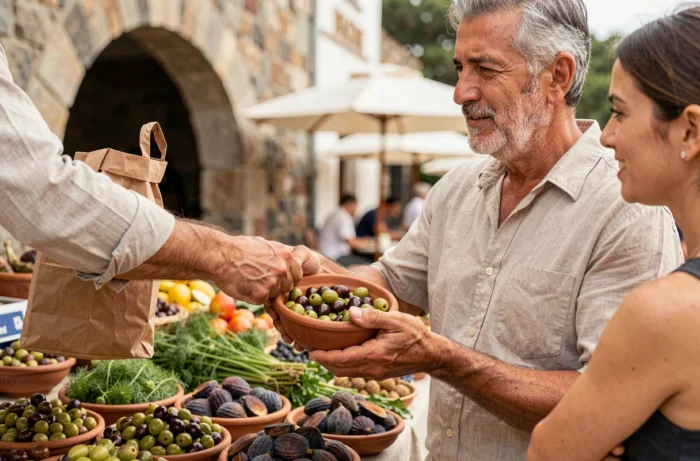
Sardinian cheeses, pane carasau, and Gallura wines: what the stalls tell about the terroir
The markets in northern Sardinia provide access to products that are hard to find outside the island. Among the most representative:
- Sheep cheeses, particularly pecorino sardo in its various maturations, occupy a central place at most food stalls. Some producers also offer casu marzu, a larval cheese whose commercialization remains legally complex in Italy.
- Pane carasau, a crispy flatbread typical of the Sardinian pastoral tradition, comes in plain or seasoned versions (pane guttiau, drizzled with olive oil and salt).
- Gallura wines, particularly Vermentino di Gallura DOCG, regularly feature at producers’ markets. This white grape variety finds in the granite and wind of Gallura conditions that give it a distinct mineral character.
The interest of these markets lies in the direct contact with the producer. Explanations about aging methods, grape varieties, or heirloom tomato varieties cannot be found on a supermarket label. This dialogue, often in Italian or Gallurese dialect, is part of the experience.
Sagre and village festivals: the other side of Sardinian markets
Beyond the weekly markets, northern Sardinia organizes sagre (village gastronomic festivals) that deserve to be distinguished. Calangianus, for example, hosts the Sagra del Bovino Gallurese, centered on local beef. These events are not markets in the strict sense: they combine communal dining, music, and product sales, over one or two days.
Sagre function as concentrated showcases of a product or tradition. Their scheduling, often in summer, varies from year to year. The available data does not always allow for confirming dates well in advance, as municipal decisions sometimes come late.
The weekly markets in northern Sardinia are neither formatted tourist attractions nor folkloric remnants. Their composition evolves under the influence of regulation, seasonality, and the variable commitment of municipalities. Coming across a Campagna Amica market in Alghero on a summer morning or stumbling upon a sagra in Calangianus is as much about preparation as it is about the randomness of the calendar.