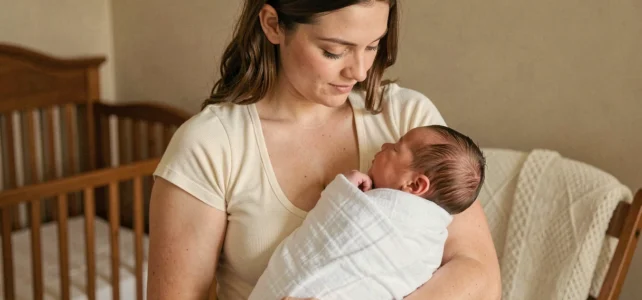
A newborn transitions from a curled posture to standing in less than fourteen months. This journey relies on a succession of motor, sensory, and cognitive acquisitions that unfold in a specific order. Supporting this motor development requires understanding what happens at each stage, adapting the environment, and respecting each child’s unique pace.
Infant wake windows: the benchmark that classic guides overlook
Most resources on baby sleep focus on the total number of hours of rest per day. Health professionals use another, more operational indicator: the wake window, which is the optimal duration between two sleep phases.
From birth to six weeks, this window is between 45 and 60 minutes. It then gradually extends to five to six hours by 19-24 months. A baby kept awake beyond their wake window enters a phase of overstimulation that paradoxically makes falling asleep more difficult.
To identify the end of the window, the signals are physical: the baby rubs their eyes, turns their gaze away, yawns, or becomes fidgety. Offering sleep at this precise moment, rather than at a fixed time, allows you to align the rhythm with the child’s actual neurological maturity. Specialized resources provide information on everything about Parent Ultime and delve deeper into these age-related benchmarks.
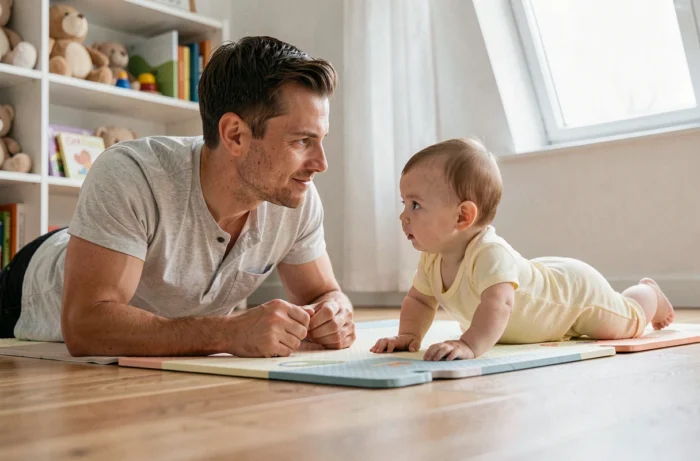
Safe sleep for babies: updated recommendations in France
The French recommendations for 2026 go beyond the simple “putting the baby to sleep on their back.” The Ministry of Health emphasizes several simultaneous points to prevent sudden infant death syndrome.
- The baby sleeps in the parents’ room for at least the first six months, but in a separate bed, without any soft objects: no bumper pads, no pillows, no stuffed animals, and no second mattress in a travel crib.
- The room temperature is maintained between 18 and 19 °C, which is sufficient with a sleep sack appropriate for the season.
- Bed-sharing with parents is still discouraged, including during naps, regardless of duration.
These recommendations form a coherent set. Applying back sleeping while leaving a duvet in the bed, for example, reduces some of the benefits. The sleep environment must be considered as a whole.
Acquisition of free motor skills: from the floor to first steps
Free motor skills are based on a simple principle: the baby acquires each posture by themselves, without being placed in a position they do not yet master. Practically, this means laying the infant on their back, on the floor, on a firm mat, and letting them explore.
The major motor milestones and their logical order
Rolling from back to belly generally occurs before rolling from belly to back. Next comes maintaining the head in a prone position, then sitting without support, crawling (which is not systematic), standing with support, and finally, independent walking.
Each acquisition prepares for the next. A baby who spends time on their tummy strengthens the extensor muscles of the back and neck, which conditions sitting stability. Placing a baby in a sitting position before they can do it themselves may hinder the intermediate muscle work and delay exploration on the floor.
What truly promotes walking
The floor remains the best ally for motor development. Walkers (youpala) have been discouraged by health professionals in France for years: they promote a walking posture on tiptoes and reduce the time spent on the floor.
Being barefoot, or in non-slip socks indoors, allows the baby to feel the ground, adjust their balance, and strengthen their arches. First shoes are only necessary outdoors, once walking is established, and should be flexible.
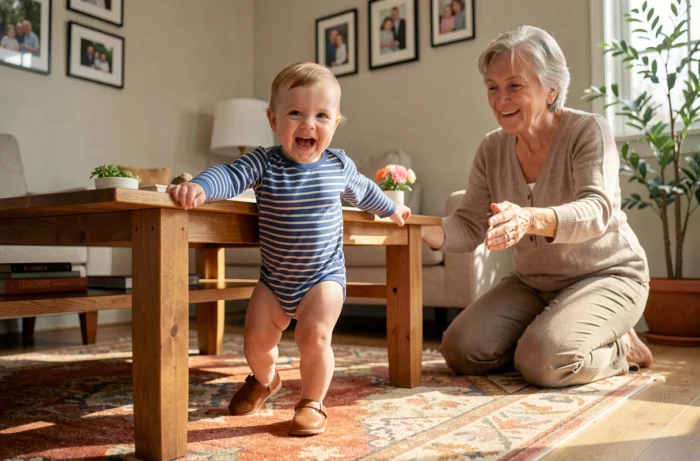
Sensorial awakening and first interactions: adapting stimuli to age
Awakening games do not need to be sophisticated. What matters is their suitability for the baby’s perceptual maturity.
Before three months, vision is blurry beyond about thirty centimeters. Black and white contrasts capture attention, and the parent’s face remains the most powerful stimulus. A lightweight rattle and a simple mobile are sufficient during this period.
Between three and six months, voluntary grasping begins to develop. Offering objects of varied textures, weights, and sizes encourages tactile exploration. The baby starts bringing objects to their mouth: this is a normal mode of exploration, not a behavior to be corrected systematically.
From six to twelve months, object permanence develops. Peek-a-boo games, shape sorters, and partially hidden objects stimulate this cognitive acquisition. The baby gradually understands that an object continues to exist even when they can no longer see it.
Food diversification: a timeline that has shifted
The WHO recommends exclusive breastfeeding for the first six months. In France, food diversification can begin between four and six months based on the pediatrician’s advice, depending on the baby’s digestive maturity and signs of readiness (head control, interest in food, disappearance of the tongue extrusion reflex).
The introduction of major allergens (peanuts, eggs, fish) is no longer delayed. Recent data supports early exposure between four and six months to reduce the risk of allergies, in small quantities and in appropriate forms (purees, diluted powders).
Breast milk or infant formula remains the foundation of nutrition throughout the first year. Solid foods are complementary, not a replacement.
Each baby progresses through these stages at their own pace. A gap of a few weeks from the usual benchmarks does not constitute a delay. The role of parents is to provide a safe environment, varied exploration opportunities, and attentive observation of the child’s signals, without forcing any acquisition.