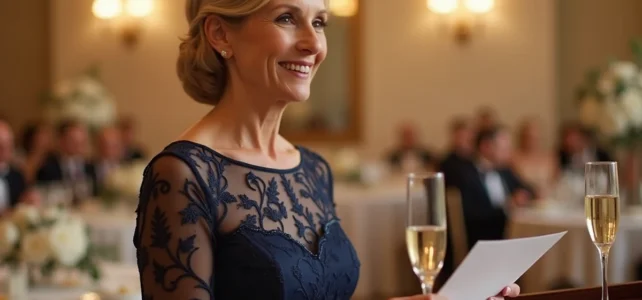
A parent’s speech at a wedding relies on a precise balance between two opposing registers: humor and emotion. Successfully navigating this task requires mastering the blend of funny anecdotes and moments of sincerity, without tipping into a sketch or melodrama. The recommended target duration by wedding professionals is around three to four minutes, which is about one and a half pages of well-spaced text. This short format necessitates clear choices in content.
Guest listening fatigue: the constraint the speech must integrate
Wedding ceremonies now incorporate more rituals than they did ten years ago. Secular ceremonies, musical interludes, readings, group games: the number of speeches is multiplying. Wedding planners and videographers have observed a clear trend in recent years to shorten each intervention to maintain the overall attention of the assembly.
A parent’s speech that is too long (beyond five minutes) has the opposite effect of what is intended. Emotion wanes, laughter becomes polite, and guests disengage. Writing an effective humorous wedding speech for parents means being willing to cut passages you love to keep only the most impactful ones.
Three to four minutes are sufficient to include two anecdotes, a moment of emotion, and a direct address to the couple. Beyond that, the speech loses intensity in exchange for length.
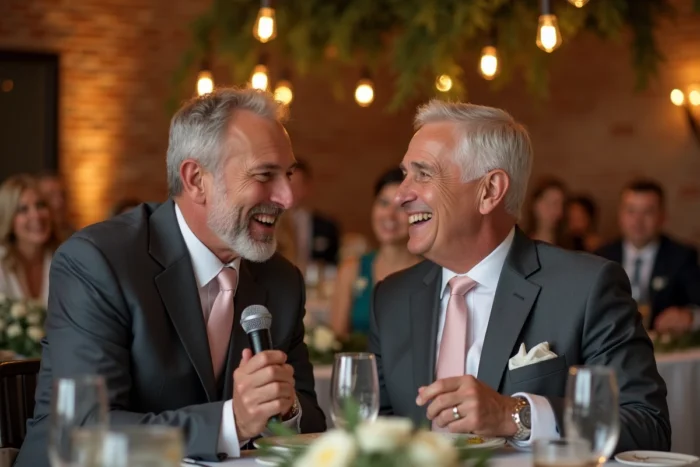
Wedding anecdote from parents: choosing the right story
The choice of anecdote determines the success of the speech. A good anecdote serves three functions simultaneously: it makes people laugh, reveals a character trait of your child, and creates a bridge to their couple’s life.
What works in an anecdote
- A precise scene with a location, an age, and a visual detail. “At six years old, in grandma’s kitchen, she decided to bake a wedding cake for her stuffed animals” works because the image is clear.
- A contrast between the child of yesterday and the adult of today. The contrast provokes laughter without exaggeration.
- A short punchline, in one sentence. An anecdote that requires explanation does not make people laugh.
What to avoid
Stories that make people uncomfortable (ex-partners, embarrassing teenage antics, family conflicts even if “resolved”) have no place here. The basic rule: if the person concerned wouldn’t laugh upon hearing the story, it should not be included in the speech.
Test your anecdote with someone close who knows little about the context. If this person smiles, the story works. If they need clarification to understand, the anecdote is too internal.
Tone of the wedding speech: balancing humor and emotion without rupture
The classic trap is to separate the speech into two blocks: first the funny part, then the emotional part. This division creates an artificial tonal break. Humor and emotion work better when they alternate throughout the text.
A funny anecdote can end with a tender sentence. An emotional memory can be introduced with a light remark. It is this alternation that gives the speech its natural character and prevents the audience from settling into a single register.
The pivot sentence
Every successful speech contains what can be called a pivot sentence: the moment when the tone shifts from humor to sincerity. This sentence usually comes about two-thirds of the way through the speech, after the anecdotes, before the final address to the couple.
It often takes the form of a simple observation. No need for lyricism. “And then one day, you introduced us to [first name], and we understood” is enough to create the shift. The silence that follows this sentence is as important as the words.
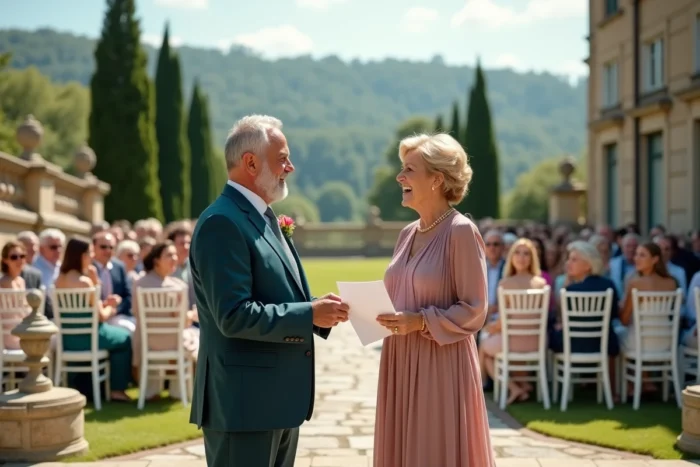
Concrete structure of a successful parents’ speech
Rather than a rigid plan, here’s a progression that has proven effective in oral delivery.
- Opening in one or two sentences: greet the assembly without a solemn formula, set the tone with a light remark or a self-deprecating comment about speaking.
- First anecdote (funny): the most visual one, the one that captures attention immediately. It concerns your child, not you.
- Transition to the couple: how your child has changed, grown, or what the arrival of their partner has altered.
- Pivot sentence: a sincere, short phrase, without emphasis.
- Address to the couple: speak directly to the newlyweds, not to the assembly. The most powerful part of a speech is when the parent looks at their child.
- Closure: raise your glass or make a concrete wish (not an abstract wish for eternal happiness).
This structure fits on one and a half pages. If your text exceeds two pages, it likely contains one anecdote too many or a digression that needs cutting.
Blended families and diverse configurations: adapting the speech
Current family configurations (blended families, separated parents, same-sex marriages) modify the codes of the parental speech. The tone must include without highlighting the differences.
A stepparent who speaks does not need to justify their legitimacy. They talk about their bond with the child, shared moments, just like any parent. A couple of separated parents can choose to each give a short speech or a joint speech: in both cases, prior agreement on the content avoids redundancies and discomfort.
For same-sex marriages, the anecdotes and tone remain the same. The only adaptation concerns gendered phrases by habit (“your future husband / your future wife”) that should be checked during proofreading.
The last point to decide before the big day: read your speech aloud at least three times. The written text and the spoken text are two different things. A fluid sentence in writing can become a trap when spoken if it contains too many subordinate clauses. What matters is that the newlyweds recognize your voice in your words.