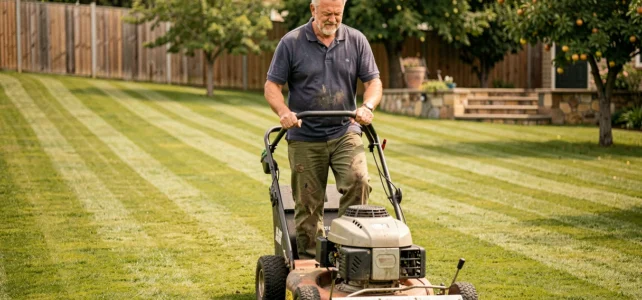
On a 2500 m² of land, choosing a mower is not just about the area. A flat and open plot does not impose the same constraints as a sloped terrain, cut by flowerbeds or bordered by narrow zones. It is the topography that dictates the type of machine, long before considering the engine or brand.
Sloped terrain, fragmented zones: the real selection criterion for 2500 m²
It is often thought that a ride-on mower solves all problems beyond 2000 m². In practice, as soon as the terrain has a marked slope or narrow passages between trees, the ride-on mower loses much of its appeal. Its turning radius limits maneuverability, and on a steep slope, stability becomes a real concern.
For this type of configuration, a self-propelled gas mower with regular transmission often remains the most versatile choice. You retain the power of a gasoline engine, the autonomy needed to cover the area, and maintain maneuverability in tight spots. If you are looking to determine precisely which mower to maintain 2500 m², the shape of the terrain weighs as much as the number of square meters.
On slopes, Matenor recommends a hydrostatic transmission rather than a classic mechanical gearbox. This system avoids jolts during gear changes and protects the mechanics in the long term. Feedback varies on this point depending on the actual elevation, but beyond a slope noticeable while walking, the difference in comfort is clearly felt.
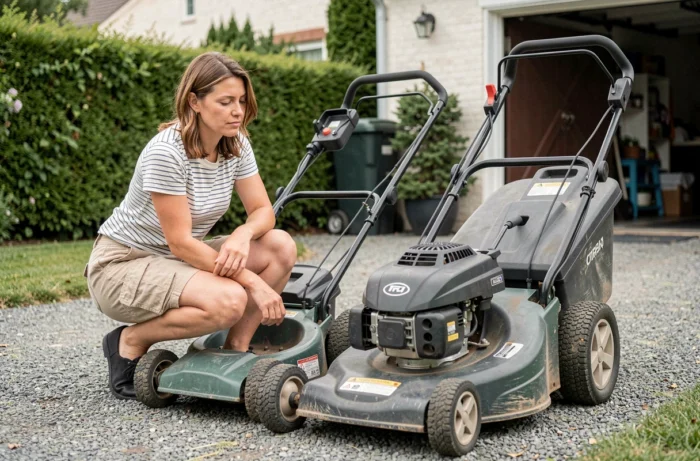
Ride-on, robot, or self-propelled gas mower: decide based on terrain accessibility
Each technology has a specific area of relevance on 2500 m². The trap is to reason solely in terms of surface area while the accessibility of each zone of the terrain changes everything.
Gas ride-on mower: the solution for open terrain
The ride-on mower makes sense on an open plot, with few obstacles and wide passages. With a cutting deck of 76 to 96 cm (recommended range by Ryobi for areas of 1500 to 5000 m²), you significantly reduce the number of passes. The time savings are real on a rectangular terrain without complications.
However, as soon as there are flowerbeds, low hedges, or access through a narrow gate, the ride-on mower forces you to revisit certain areas by hand. You end up with two machines instead of one.
Robot mower: effective but under conditions
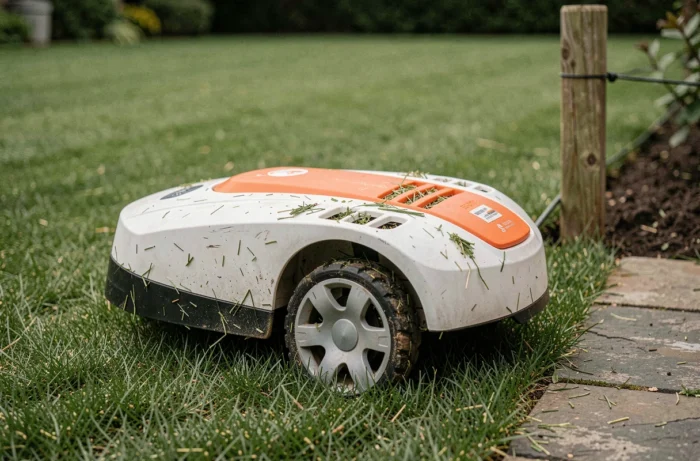
A robot mower covers 2500 m² without human intervention, provided the terrain is properly wired or mapped. Recent models handle moderate slopes and operate autonomously.
The downside is the overall cost. Frandroid emphasizes that you need to factor in the periodic replacement of blades and the battery, two often underestimated expenses at the time of purchase. On fragmented terrain with several separated zones, installing the perimeter wire or configuring multi-zones complicates the setup.
Self-propelled gas mower: the compromise for difficult terrain
For partially sloped terrain, with areas inaccessible to a ride-on mower, the self-propelled gas mower remains a reliable foundation. You push it less than you think thanks to the traction, and it can go anywhere.
- Recommended cutting width for over 1000 m²: 51 to 53 cm according to Ryobi, which adequately meets needs without making the machine too heavy in tight turns
- Gas engine for complete autonomy on 2500 m² without recharging or extension cords
- Maneuverability in narrow passages, around trees, and along edges, where a ride-on mower cannot go
Cutting width and mowing time on 2500 m²: the real benchmarks
The cutting width directly determines the time spent mowing. On 2500 m², the difference between a 46 cm deck and a 53 cm deck translates to several fewer back-and-forth passes with each mowing. Over a full season, the total represents several hours of saved work.
With a self-propelled mower at 51-53 cm width, you cover the area in a reasonable time without sacrificing maneuverability. A ride-on mower with a deck of 76 cm or more will obviously go faster, but only in areas where it can move freely.
The choice thus comes down to concrete terms: if more than three-quarters of the terrain is open and flat, the ride-on mower optimizes mowing time. If the terrain has sloped areas, corners, or narrow passages, a self-propelled gas mower at 51-53 cm covers everything without a complementary machine.
Overall budget for a mower for 2500 m²: include maintenance from the purchase
Prices are often compared without looking at what the machine will cost over five years. This is a common mistake, especially when hesitating between a robot and a gas mower.
- Robot mower: higher purchase price, to which you must add the blades (to be replaced regularly) and the battery (limited lifespan)
- Gas ride-on mower: significant initial investment, standard engine maintenance (oil change, filter, spark plug), but cheaper consumables per unit
- Self-propelled gas mower: the most accessible purchase price of the three, simple maintenance, and widely available parts
On a 2500 m² plot, the cost of use over several seasons can reverse the ranking compared to the catalog price. A well-maintained self-propelled gas mower remains functional for a long time with a modest consumables budget.
The last point to check before purchase is the grass ejection mode. Mulching (shredding and redistributing on-site) reduces collection time and nourishes the lawn. On 2500 m², not having to empty a bag every ten minutes significantly changes the mowing experience. Most self-propelled gas mowers offer this option, sometimes as a complementary kit.