
When you find chewed cables in the attic or traces of droppings on the insulation, the question of trapping quickly arises. Before rushing to the hardware store, it’s wise to check two crucial points: the legal status of the stone marten in your department and the type of trap that can actually be used by an individual. Without these checks, you risk a fine and confiscation of your equipment.
Local regulations on trapping stone martens: what to check before purchasing
The stone marten is not automatically listed as a species that can cause damage in all departments. This list, set by prefectural decree, determines whether you are allowed to capture it at home. A trap purchased in a department where the stone marten is classified as harmful becomes unusable if you move to a department where it is not.
Trapping is reserved for trappers authorized by the prefecture, except for exceptions defined locally. In practice, some departments allow the owner or tenant to set a capture cage on their property, while others require the intervention of a registered trapper. Before any expenditure, consult the current prefectural decree or contact the departmental federation of hunters.
This legal framework makes purchasing at a large hardware store less innocuous than it seems. You may end up with a perfectly functional cage that is legally unusable. Returns on this point vary by department, hence the necessity to inquire before checking out.

Capture cage or lethal trap: which model to find in the hardware store
In the aisles of Brico Dépôt or similar stores, you mainly find two families of devices. Live capture cages, often made of galvanized wire with a swinging door, allow you to catch the animal without injuring it. Lethal traps like Conibear, jaw traps, or spring traps kill the animal instantly.
For an individual, the live capture cage remains the only reasonable choice. Lethal traps are subject to strict approval conditions, and their use almost always requires a trapping license. Handling them without training exposes you to injuries (the springs are powerful) and legal action if a non-target animal is caught.
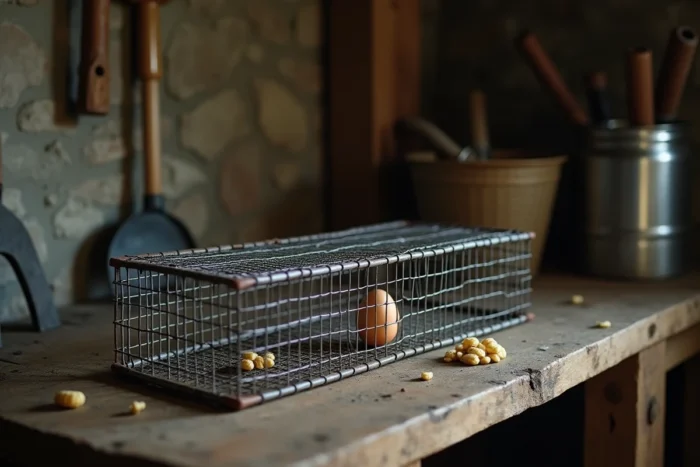
When looking to buy a stone marten trap at Brico Dépôt, you should therefore opt for a wire cage of suitable dimensions for an adult mustelid. Size matters: a cage that is too small prevents the door from closing properly, while a cage that is too large reduces the effectiveness of the trigger.
Concrete criteria for evaluating a cage on the shelf
- The mesh of the wire must be tight enough so that a stone marten cannot pass a paw through and force the opening. A mesh that is too wide renders the cage ineffective.
- The triggering mechanism must be sensitive to the weight of an adult stone marten, but not so sensitive that it closes at the slightest draft. Test the trigger plate by hand before purchasing.
- The door must lock automatically once closed. Some entry-level models have a simple gravity latch that the stone marten can lift from the inside.
- Galvanized steel withstands the humidity of the attic or garage better than simple painted wire. Check for rust on the welds.
Baits and positioning of the stone marten trap: mistakes that lead to failed captures
Placing a cage in the middle of the attic with a piece of bread yields nothing. The stone marten is a wary, nocturnal animal that follows regular paths along walls and beams. The trap should be placed on an identified passage, never in an open area.
You can identify these passages by looking for droppings (small dark clumps, often twisted) and claw marks on vertical surfaces. Once the path is identified, position the cage against the wall, in the direction of the animal’s movement, with the opening facing its usual approach area.
Choosing the bait: what works in the field
The stone marten is omnivorous with a clear preference for animal proteins and sweet fruits. A whole egg (with the shell intact) placed at the bottom of the cage works well: the smell attracts the animal without dissipating too quickly. Pieces of raw meat or fish also yield results, but they attract other species (cats, hedgehogs) and require frequent replacement in summer due to rapid decomposition.
An effective bait stays in place for several days without losing its attracting power. Very ripe fruits (grapes, plums) make a good complement placed in front of the cage entrance to create an olfactory trail to the trigger.
What to do after capturing a live stone marten
Capturing the animal only solves half the problem. Regulations require you to release the stone marten within a radius defined by the prefectural decree, often several kilometers from the capture site, in a suitable natural environment. Killing it after capture without authorization constitutes an offense.
Transport the cage covered with an opaque cloth to limit the animal’s stress (a stressed stone marten may bite through the wire and injure itself). Release should be done at dawn or dusk, in a wooded area away from human dwellings.
Once the stone marten is removed, sealing all access points to the attic or garage remains the only sustainable prevention. The stone marten can pass through openings just a few centimeters wide. Inspect the roof edges, cable passages, and vents. Without this sealing work, a new stone marten will occupy the freed territory within weeks.
Trapping without sealing is like emptying a bathtub without turning off the tap. The real investment at Brico Dépôt, beyond the cage, is the intrusion-proof mesh, expanding foam, and zinc sheets to secure the identified entry points.