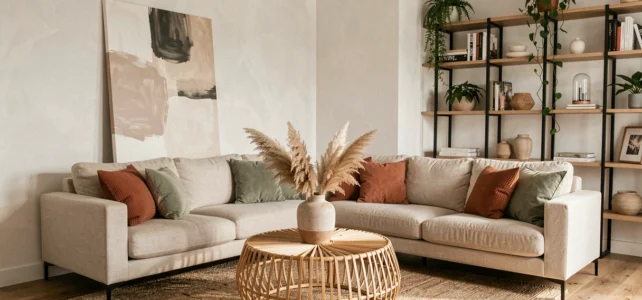
A living room wall repainted in greige three weeks ago, an old armchair found at an online flea market, and yet the whole doesn’t work. The problem rarely stems from taste, but from a lack of method in assembling current decor trends without turning one’s interior into a catalog. Here’s how to take control of some concrete levers that truly change the ambiance of a room.
Warm neutral color palette: laying the right foundation before everything else
We often start by choosing a piece of furniture or a decor item, while the wall color dictates everything else. The decor trends for 2026 confirm a clear shift: cool whites and pure grays are giving way to warm neutrals like beige, sand, and greige.
Pantone has designated the shade Cloud Dancer (11-4201) for 2026, a bright off-white with very subtle gray undertones. This color works as a backdrop on which deeper accents can be placed: burgundy, olive green, navy blue.
In practice, one can start with just one wall painted in an organic shade (burnt ochre, deep terracotta, sage green) and keep the rest in warm neutral. High-end paint brands like Farrow & Ball, Ressource, or Little Greene are seeing a strong demand for these organic shades, far from the cool grays that dominated the 2010s.
You can also find concrete ideas for pairing these colors with existing furniture on Cécile Bricole’s decor, especially for living spaces.
- Greige (gray-beige) works in a north-facing living room as well as in a bright bedroom; it is the most versatile neutral at the moment.
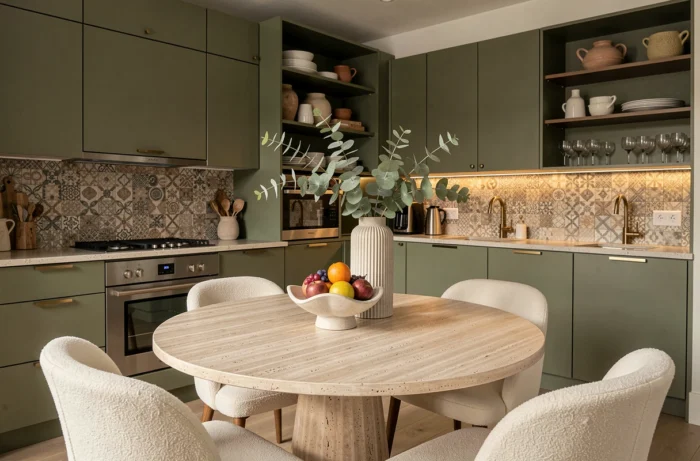
- Sage green pairs particularly well with light wood and brushed brass, two materials very present in current interiors.
- Burgundy, used on a single wall or an accent piece, adds depth without darkening the space if the rest of the palette remains light.
Natural materials and sustainable furniture: what replaces fast decor
The most structuring trend of recent years is not a style; it is a purchasing reflex. There is a marked distancing from fast decor, those cheap furniture and accessories that are replaced every season. The preference now leans towards durable, repairable pieces, or simply second-hand items.
This movement is encouraged by European eco-design policies and campaigns from ADEME in France. In practice, this translates into a massive return of raw wood, rattan, linen, and woven fibers in interior decoration.
How to integrate natural materials without changing everything
There’s no need to empty your living room. A solid oak tabletop placed on an existing base, washed linen cushions on a basic sofa, a wicker basket replacing a plastic bin: these targeted substitutions change the ambiance without a big budget.
Wood, in all its forms, remains the most sought-after material. Reactions vary on this point depending on the chosen species: light oak gives a Scandinavian look, walnut leans towards mid-century, and raw pine pushes towards a more rustic style. The choice of species influences the style as much as the color of the walls.
Living room and bedroom decor: two rooms, two logics
Applying the same decor recipe to the living room and bedroom is a common mistake. These two spaces serve different functions, and current trends take this into account.
The living room: a space for expression
This is the room where one can afford bold shapes in furniture, bolder colors on the walls, and texture combinations. A curved sofa (very present in the 2026 collections), a boucle wool rug, and a brass light fixture are enough to anchor a style without overwhelming it.
Mixing two or three different textures in the living room creates visual depth without resorting to an accumulation of objects. A corduroy fabric on the sofa, raw wood on the coffee table, and linen on the curtains form a coherent trio.
The bedroom: priority to visual calm
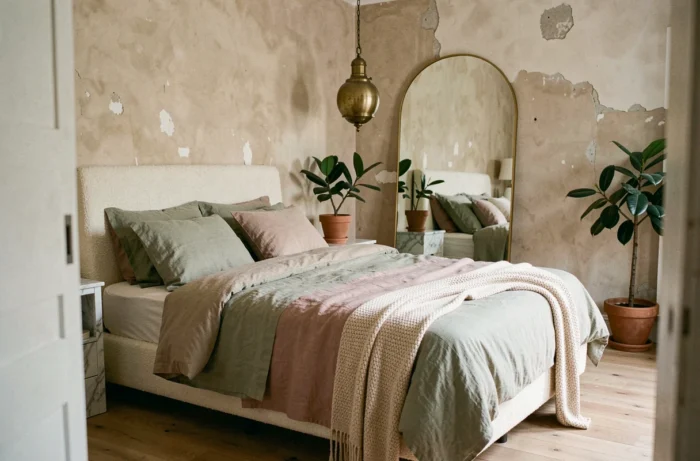
The decor trends for the bedroom go in the opposite direction. Contrasts are reduced, soft shades (ivory, sand, powder pink) are favored, and the number of visible objects is limited. The headboard becomes a central element of the decor again, with tufted fabric or carved wood models replacing the minimalist versions of previous years.
A detail that makes a big difference: harmonizing the color of the bedding with that of the walls rather than seeking contrast. This tone-on-tone approach visually enlarges the room and enhances the cocooning sensation.
Walls and biophilic design: the trend that transforms a hallway or kitchen
Biophilic design, which involves integrating living natural elements into interior design, goes far beyond just a green plant on a shelf. We are talking about stabilized plant walls for an entryway, planters built into a kitchen cabinet, or natural moss framed like a painting.
This approach works particularly well in spaces that are rarely decorated: hallway, bathroom, kitchen. A stabilized moss wall in a narrow hallway absorbs some noise and adds an organic texture where only white paint is expected.
- Stabilized moss requires neither watering nor light, making it suitable for windowless rooms.
- Hanging plants in macramé are making a strong comeback, driven by the appeal of natural fibers.
- Open wooden shelves in the kitchen, filled with stoneware pots and aromatic plants, combine useful storage with a plant ambiance.
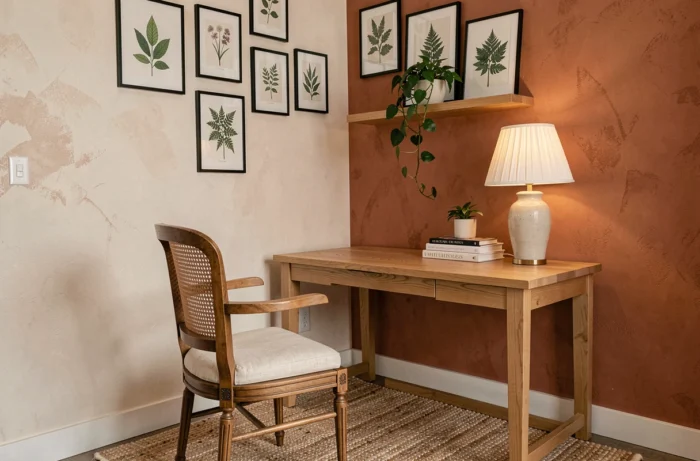
The common thread of all these decor trends remains the same: prioritize sustainable choices and authentic materials rather than chasing every novelty. An interior that ages well is built on solid foundations (warm neutral colors, natural materials) onto which a few seasonal accents are grafted. It’s better to have three well-thought-out modifications than a complete overhaul every two years.