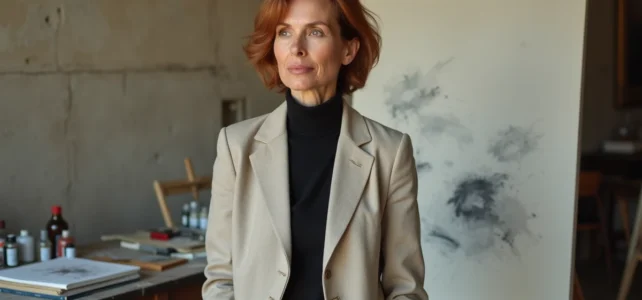
When you type the name Béatrice Vonderweidt into a search engine, the results predominantly lead to photos, rarely to her paintings. This gap between public curiosity and the reality of an artistic journey from modeling to painting raises a measurable question: what legal framework truly protects the image of a person who has changed careers, and how does French law distinguish between the different uses of these images?
Capturing, recording, and transmitting images: three distinct legal acts since 2026
The right to one’s image in France is based on Article 9 of the Civil Code, which protects the private life of every individual. Article 226-1 of the Penal Code specifies the offenses related to the capturing, recording, and transmission of images in a private place. Until recently, the boundary between these three acts remained unclear in case law.
A ruling from the criminal chamber of the Court of Cassation on June 23, 2026 (n° 25-82.188) changed the game. The Court stated that any recording or transmission of a person’s image in a private place is punishable as long as it is done without their knowledge, even if the initial capturing was consented to.
To understand the concrete implications of this distinction applied to the photos of Béatrice Vonderweidt in France, it is necessary to measure what each act implies separately.
| Material Act | Definition | Required Consent |
|---|---|---|
| Capturing (fixing) | Taking the photo or filming the scene | Consent to being photographed |
| Recording | Storing the image on a durable medium | Specific consent, distinct from capturing |
| Transmission (distribution) | Sharing the image with third parties or online | Explicit consent for distribution |
This autonomy of the three material acts means that a photo taken with the person’s consent in a private studio cannot be published online without new consent specifically regarding the distribution.
Model’s image rights and artist’s image rights: two overlapping regimes
Béatrice Vonderweidt’s journey, a former model turned painter, illustrates a legal case rarely addressed by competitors: the coexistence of two image statuses for the same person.
Image remuneration in modeling
Under French labor law, the image of the model is subject to a limited contractual transfer. The modeling contract specifies the duration, medium, and territory of exploitation of the images. Once the contract expires, the reuse of the photos requires a new agreement. This framework is distinct from the “classic” right to image under Article 9 of the Civil Code.
Protection of personal image after career change
When a person leaves modeling for an artistic activity, the photos taken in the previous professional context remain subject to the clauses of the original contract. In contrast, any image captured in the context of the new activity (studio, private opening, daily life) falls under the general regime of the right to private life.
The frequent confusion online arises from the fact that some sites reuse old professional images out of their contractual context, sometimes to illustrate articles unrelated to fashion or art. Reusing a modeling photo outside of the contract constitutes an infringement of the right to image, regardless of the person’s notoriety.
Spouse of a public figure and image rights: the status of Béatrice Vonderweidt
Béatrice Vonderweidt is also known as the wife of lawyer Gilles-William Goldnadel, a media figure regularly present in public debates. This marital link does not alter her personal legal protection in any way.
French law clearly distinguishes the public person from their spouse. Three criteria determine whether the dissemination of an image is lawful:
- The location of the shot: a public space (street, open event) offers less protection than a private place (home, closed studio)
- The context of publication: a photo illustrating a news topic related to the person differs from a purely decorative use on a blog unrelated to their activity
- Explicit consent: even in a public place, the photographed person can oppose commercial or diverted use of their image
The fact that Gilles-William Goldnadel is a media personality does not create any derivative rights over his wife’s image. The spouse of a public figure retains all of their rights to privacy.
Searching for images online and concrete risks for internet users in France
The majority of results associated with the query “Béatrice Vonderweidt photo” lead to pages with limited factual content. Several sites use her image as a generic illustration, without any link to her actual artistic journey.
Since the ruling of June 23, 2026, the risks have also become clearer for internet users who share these images. The transmission of a photo taken in a private place, even found online, can engage the liability of the person sharing it if no consent for dissemination has been given by the represented person.
Social media platforms are receiving an increasing number of removal requests based on Article 226-1 of the Penal Code and the GDPR, which qualifies a person’s image as a personal data subject to the right of opposition. This dual basis (Penal Code and GDPR) strengthens the position of individuals whose images circulate without authorization.
Béatrice Vonderweidt’s journey thus concentrates several legal issues rarely combined in one person: former contractual transfer of image in fashion, enhanced protection of private life after artistic career change, status as the spouse of a media personality. The June 2026 ruling on the autonomy of the acts of capturing, recording, and transmitting adds a layer of protection that makes the unauthorized reuse of her photos riskier than ever for both site publishers and internet users.